Electronics · Ch 7 — Wireless Communication
Ionosphere
Ionosphere
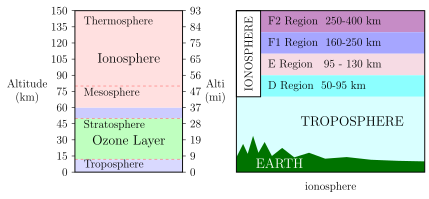
Radiations, especially ultraviolet rays, coming from the sun cause the gases of the upper atmosphere to ionize — that is, to become electrically charged. This produces a relatively thick but invisible shell of charged particles called the ionosphere, which extends over altitudes of roughly 50 km to 400 km. It is the ionosphere that supports MF and HF wave propagation.
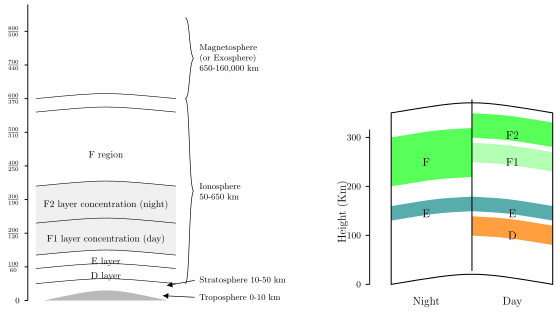
The ionosphere is generally treated as being divided into three basic layers, named the D, E and F layers. The D and E layers are only weakly ionized, because they are far from the sun's direct effect, and they exist only during the day. The F layer is more strongly affected and, during the day, splits into two separate layers, and ; these are highly ionized and are the most effective on HF signals. The F layer is present both day and night (Figure 7.6).
[!NOTE]
The illustration on this page shows the atmospheric layers and the D/E/F regions with approximate altitude bands (for example the E region marked as 95–130 km). Treat these picture values as rough visual guides; the layer altitudes and thicknesses given in the text below are the ones to learn for the exam.
The main features of each layer are as follows.
(a) D layer
- It has an average thickness of about 10 km and extends up to an altitude of roughly 70 km.
- It disappears during the night.
- It reflects VLF and LF waves but absorbs MF and HF waves.
(b) E layer (Kennelly–Heaviside layer)
- It has an average thickness of about 25 km and is present at an altitude of roughly 100 km.
- Like the D layer, it disappears at night.
- It helps MF propagation and partially helps HF wave propagation.
(c) F layer (Appleton–Barnett layer)
The F layer begins at about 150 km and extends up to about 400 km, and it remains present both day and night. During the daytime it splits into two layers, and , which combine again into a single F layer at night.
layer
- It lies at an average altitude of about 200 km.
- Its approximate thickness is about 200 km.
- It partially reflects HF waves.
layer
- It lies at an average altitude of about 300 to 400 km.
- Its average thickness is around 200 km. …
Drawn by us to help you understand the concept clearly, and verified to make sure it's accurate. For exams, practice from your textbook's own diagram.
Corresponds to the ionosphere illustration on this page: one panel shows the atmospheric layers (troposphere, ozone layer, stratosphere, mesosphere, ionosphere, thermosphere) against altitude, and the other shows the ionospheric D, E, F1 and F2 regions stacked above the troposphere and the earth. It gives a visual feel for where the charged layers sit. (Th …
Drawn by us to help you understand the concept clearly, and verified to make sure it's accurate. For exams, practice from your textbook's own diagram.
Reproduces Figure 7.6: altitude graphs of the D, E, F, F1 and F2 layers, with a day/night comparison showing the single F layer at night splitting into F1 and F2 during the day. It supports t …