Electronics · Ch 7 — Wireless Communication
Sky wave propagation
Sky wave propagation
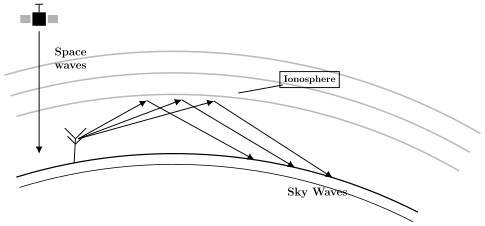
As already mentioned, sky-wave propagation makes use of the ionosphere to refract and reflect radio waves so that they can be sent over long distances (Figure 7.7.a). Whenever radio waves enter the ionosphere, both reflection and refraction take place. How much of each occurs depends on the charge density of the ionosphere and on the frequency and angle of incidence of the radio wave.
Several important terms are used when describing this kind of propagation.
(i) Critical frequency ()
For a given ionospheric layer, the critical frequency is the highest frequency of a beamed radio wave that will still be returned to the earth by that layer. For the layer, for example, lies in the range of about 5 MHz to 12 MHz.
(ii) Critical angle ()
The critical angle is the maximum angle of incidence (within the usable frequency) at which a radio wave sent into the ionosphere is still returned to the earth. Signals beamed in above the critical angle simply penetrate the layers and escape into outer space without being returned.
(iii) Skip distance ()
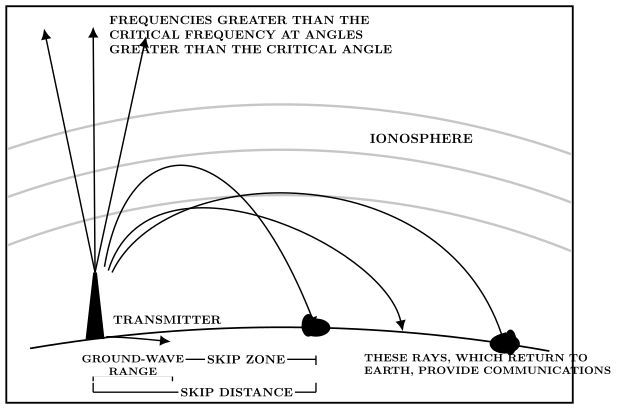
The skip distance is the shortest (minimum) distance, measured along the surface of the earth, between the transmitting antenna and the first receiving antenna that picks up the wave after ionospheric propagation (Figure 7.7.b).
(iv) Skip zone or silent zone
The skip zone, also called the silent zone, is the region around the receiving side — lying within the skip distance — where neither the ground wave nor the sky wave is received, so no signal is heard there (Figure 7.7.b).
(v) Single hop distance
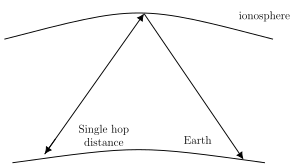
The transmission path is limited both by the skip distance and by the curvature of the earth. The single hop distance is the maximum distance, measured along the earth's surface, between the transmitting antenna and the first receiving antenna after one ionospheric bounce (Figure 7.7.c). For the layer this can be as much as about 4000 km. Since the average semi-circumference of the earth is about 20000 km, a signal must undergo several hops to achieve round-the-globe communication.
(vi) Multiple hop transmission
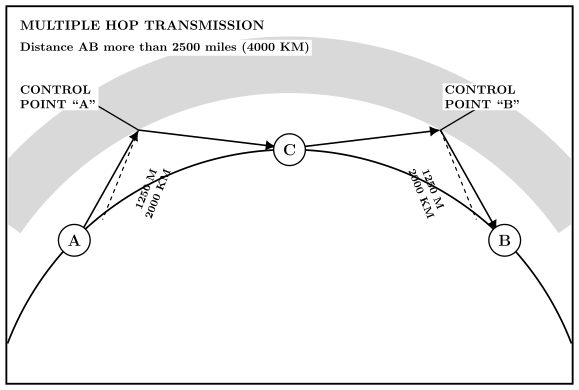
Multiple hop transmission uses repeater stations that receive the ionospheric signal, reflect and re-transmit it, so the wave makes several successive hops (Figure 7.7.d). This technique is used extensively for long-distance communication.
(vii) Fading …
For a given ionospheric layer, the critical frequency is the highest frequency of a beamed radio wave that the layer will still bend back to the earth. Waves above this frequency escape into space. For the l …
The critical angle is the largest angle of incidence, within the usable frequency, at which a radio wave entering the ionosphere is still returned to earth. Waves launched above this angle penetrate the l …
The skip distance is the shortest distance along the earth's surface, from the transmitting antenna to the first antenna that receives the wave after it returns from the ionosphere. It depends on the transmitting frequency and the state of the ionosphere. Nearer than this the returning sky wave overshoots, so it is a key …
The skip zone, or silent zone, is the region lying within the skip distance where neither the ground wave nor the returning sky wave can be received, so no signal is heard there. It lies beyond the ground-wave range yet nearer than where the sky wave first returns, so a set placed here hears nothing. Its extent matters when siting H …
Drawn by us to help you understand the concept clearly, and verified to make sure it's accurate. For exams, practice from your textbook's own diagram.
Corresponds to Figure 7.7.a: rays beamed from the transmitting antenna into the curved ionosphere are bent back to the ground as sky waves, showing how the ionosphere makes over-the …
Drawn by us to help you understand the concept clearly, and verified to make sure it's accurate. For exams, practice from your textbook's own diagram.
Reproduces Figure 7.7.b: low-angle rays are returned to earth beyond the skip distance, while rays above the critical angle or critical frequency pass through the ionosphere and are lost; the ground-wave range, skip distance an …
Drawn by us to help you understand the concept clearly, and verified to make sure it's accurate. For exams, practice from your textbook's own diagram.
Corresponds to Figure 7.7.c: an inverted-V ray path from the earth up to the ionosphere and back down, with the base distance between the two ground points labelled as the single-hop distance (up …
Drawn by us to help you understand the concept clearly, and verified to make sure it's accurate. For exams, practice from your textbook's own diagram.
Reproduces Figure 7.7.d: a signal hops repeatedly between the earth and the ionosphere between control points A and B (a distance of more than about 4000 km), showing how repeater-assisted multiple hops a …