Q.The dimensions of an atom are of the order of an Angstrom. Thus there must be large electric fields between the protons and electrons. Why, then is the electrostatic field inside a conductor zero?
🔒You're viewing a preview — the full solution, concept, methods & PYQ mapping are locked.
🔒 Start your 14-day free trial to unlock the full solution →Concept understanding — Gauss Law
Gauss's Law is a shortcut. Instead of adding up the Coulomb contribution of every charge — a nightmare of vectors and integrals — it lets you read the field straight off the symmetry of a problem. The whole idea rests on one quantity: electric flux.
Flux — field-lines counted through a surface. For a uniform field E crossing a flat area A, the flux is Φ = E·A = EA cosθ, where θ is the angle between the field and the normal to the surface. Picture the field as a bundle of lines; flux is how many pierce the surface. When E is edge-on (θ = 90°) nothing passes through and Φ = 0; when E is ⊥ to the surface (θ = 0) the count is maximal. For a closed surface, Φ is the net number of lines leaving it — lines that enter and exit cancel.
The law itself. Gauss's law states that the net flux out of any closed surface depends only on the charge trapped inside:
Φ = q_enclosed / ε₀.
Two consequences do most of the work. First, only enclosed charge counts — a charge outside sends as many lines in as out, so its net contribution is exactly zero. Second, the surface's shape is irrelevant; move the charge around inside or deform the surface, and Φ never changes.
Why symmetry makes it powerful. By itself Φ = q/ε₀ has E buried in an integral. It becomes a tool only when you pick a Gaussian surface matched to the symmetry — one where E is constant and everywhere either ⊥ to the surface (so Φ = EA) or ∥ to it (contributing nothing). Then E slides out and you solve in one line. This works for exactly three geometries:
1 — Infinite line charge (linear density λ). Use a coaxial cylinder: E = λ / 2πε₀r, falling off as ∝ 1/r.
2 — Infinite sheet (surface density σ). Use a pillbox pierced through the sheet: E = σ / 2ε₀ — uniform and completely independent of distance. The field near a large charged plane simply doesn't weaken as you step back. …
Why this formula?
Gauss's Law: Why It Holds
Gauss's Law is one of the four Maxwell's equations and a cornerstone of electromagnetism. Let's build the understanding from the ground up — not just the formula, but the why.
1. The Core Idea: Flux as "Flow" of Field
Imagine an electric field E passing through a small patch of area dA. The electric flux through that patch is:
dΦE=E⋅dA=EdAcosθ
where θ is the angle between E and the outward normal to the surface.
Why this definition?
- If E is perpendicular to the surface (θ=0), maximum field "flows through".
- If E is parallel (θ=90∘), no flux — the field just slides along the surface.
Total flux through a closed surface S is:
ΦE=∮SE⋅dA
2. The Key Insight: Flux Depends Only on Enclosed Charge
Consider a single point charge +q at the centre of a spherical surface of radius r.
- By Coulomb's law, at every point on the sphere: E=4πε01r2q, radially outward.
- The area vector dA is also radially outward.
- So E⋅dA=EdA everywhere.
The total flux:
ΦE=∮EdA=E∮dA=(4πε01r2q)(4πr2)=ε0q
Notice: The r2 cancels! The flux is independent of the radius.
3. Why Shape Doesn't Matter
Now, what if the surface is not spherical but any closed shape enclosing the charge?
- Draw a small cone from the charge to the surface.
- The flux through a patch dA at distance r is dΦ=4πε01r2qcosθdA.
- But r2cosθdA is exactly the solid angle dΩ subtended by dA at the charge.
So dΦ=4πε0qdΩ.
Integrating over the entire closed surface: ∮dΩ=4π (total solid angle around a point).
Hence:
ΦE=4πε0q⋅4π=ε0q
Result: For any closed surface enclosing q, the flux is ε0q.
4. Multiple Charges: Superposition
If there are many charges q1,q2,…,qn inside the surface, the total electric field is the vector sum of individual fields:
E=E1+E2+⋯+En
Flux is linear: …
The key idea is Gauss’s Law applied to electrostatic equilibrium in a conductor.
Inside a conductor, free electrons rearrange instantly until the net electric field at every interior point is zero. If any field existed, it would push charges until they cancelled it — that is the definition of electrostatic equilibrium.
- Consider a Gaussian surface anywhere inside the conductor. By Gauss’s Law, ∮E⋅dA=ε0qenc.
- In equilibrium, E=0 everywhere inside, so the left side is zero. Hence qenc=0 — no net charge inside any interior surface. …
The electrostatic field inside a conductor is zero in equilibrium because free electrons rearrange instantly to cancel any internal field — the atomic-scale fields between protons and electrons are bound, not free, and do not contribute to the macroscopic net field.
The question touches a subtle point that often confuses students. You are right: inside an atom, the electric field between the proton and electron is enormous — on the order of 1011V/m. So how can we claim the field inside a conductor is zero? The key is to distinguish between microscopic fields (inside individual atoms) and the macroscopic average field we talk about in electrostatics.
When we say "the electrostatic field inside a conductor is zero," we mean the net macroscopic field — the average field over a region containing many atoms — is zero. This is a statement about the conductor as a whole, not about the fields inside each atom.
Let’s break this down properly.
1. What does "inside a conductor" mean?
A conductor (like copper or aluminium) has a lattice of positive ions surrounded by a sea of free electrons — electrons that are not bound to any particular nucleus. These electrons can move freely throughout the material. In contrast, the electrons in an insulator are tightly bound to their atoms.
When we place a conductor in an external electric field, the free electrons respond instantly. They drift until they arrange themselves on the surface in such a way that their own field exactly cancels the external field everywhere inside the bulk of the conductor. This is the essence of electrostatic shielding.
The zero field condition applies only to the macroscopic average field in the bulk material, not to the intense but localised fields inside individual atoms or ions.
2. The atomic fields are bound, not free
Inside each atom, the electron cloud and the nucleus produce a strong electric field — but this field is confined to the atom itself. Over distances larger than an atom (say, a few nanometres), these atomic fields average out to zero because the positive and negative charges are paired.
Think of it this way: if you take a box containing many neutral atoms, the net charge inside is zero, and the average field from all those dipoles cancels. The macroscopic field we measure is the average over many atoms, and that average is zero in a conductor at equilibrium.
A useful analogy: the air in a room has enormous molecular-scale electric fields between the nuclei and electrons of each molecule, yet you don't feel any net electric field walking through the room. The fields are local and cancel out on average.
3. What happens when an external field is applied?
Suppose you bring a charged rod near a metal sphere. The external field tries to push free electrons one way. But the electrons move so quickly (within 10−14 s) that they accumulate on one side of the sphere, creating an induced surface charge. This induced charge produces its own field that exactly opposes the external field inside the metal.
The result: inside the bulk (everywhere except a thin surface layer), the net field is zero. The free electrons have rearranged to shield the interior.
A common mistake is to think the field is zero because "there are no charges inside." That is false — there are plenty of positive ions and free electrons. The field is zero because the charges redistribute to cancel it, not because they are absent.
4. Why don't the atomic fields cause a net field? …
Concept: Electrostatic Shielding and Free Electrons in Conductors
The key idea is that conductors have mobile free electrons that can instantly rearrange themselves to cancel any internal electric field.
Method: The Free Charge Redistribution Method
Step 1: Understand the microscopic picture
- In a conductor (like copper), atoms give up their outermost electrons.
- These electrons are free to move throughout the material — they are not bound to individual atoms.
- The positive ions (nuclei + core electrons) form a fixed lattice.
Step 2: Apply an external field (or consider the atom's own field)
- If an electric field E exists inside the conductor, it exerts a force F=−eE on each free electron.
- Electrons move instantly in the direction opposite to E.
Step 3: Charge redistribution creates an opposing field
- Electrons accumulate on one surface, leaving positive charge on the opposite surface.
- This separation creates an induced electric field Einduced that points opposite to the original field.
Step 4: Equilibrium condition
- Electrons stop moving when:
Eoriginal+Einduced=0
- This happens in less than 10−16 seconds — essentially instantaneously.
Step 5: The result
- Inside the conductor, the net electrostatic field is exactly zero at equilibrium.
- The large atomic-scale fields between protons and electrons are perfectly cancelled by the rearrangement of free electrons.
Why the atomic fields don't matter …
Common Mistakes Students Make on This Question
This question tests your understanding of electrostatic equilibrium in conductors — not just the existence of electric fields inside atoms. Here are the most frequent errors:
1. Confusing Atomic Scale with Bulk Scale
Mistake: Students argue that because atoms have internal fields, the conductor must also have fields inside.
Why it's wrong: The question is about the net macroscopic field inside a conductor, not the microscopic fields between individual protons and electrons. Inside a conductor in equilibrium, charges rearrange so that the net field at any point is zero.
How to avoid: Always distinguish between:
- Microscopic fields (inside atoms, between charges)
- Macroscopic (net) field (average over many atoms)
2. Forgetting Free Electrons in Conductors
Mistake: Treating the conductor as a collection of fixed atoms, ignoring mobile electrons.
Why it's wrong: In conductors, valence electrons are free to move. When an external field is applied, these electrons redistribute until the internal field cancels the external one.
How to avoid: Remember: conductors have free charge carriers (electrons) that can move until electrostatic equilibrium is reached.
3. Misapplying Gauss's Law
Mistake: Claiming Gauss's law proves the field is zero everywhere inside, without considering charge distribution.
Why it's wrong: Gauss's law says ∮E⋅dA=ε0Qenc. For a conductor, excess charge resides on the surface, so Qenc=0 inside → E=0 inside. But this is a result of charge rearrangement, not a starting assumption.
How to avoid: Understand the cause-and-effect:
- Free electrons move in response to any field
- They accumulate on the surface
- This creates an opposing field
- Equilibrium: net field inside = 0
4. Ignoring the Time Scale of Rearrangement …
Showing the 12 most recent of 16 on this concept.
- COMEDK 2026Set 2026-A1 markMCQQ.A charge of 5μC is placed at the centre of a spherical shell S1 of radius 10 cm . Now this system is enclosed inside another spherical shell S2 of radius 20 cm . The ratio of the electrical flux through the surface S2 to S1 is : (A) 1:2 (B) 4:1 (C) 2:1 (D) 1:1
›Reveal solutionSolution
The electric flux through any closed surface depends only on the net charge enclosed, not on the size or shape of the surface. Since both spherical shells enclose the same charge, the flux through each is identical, so the ratio is 1:1.
Concept and Intuition
This problem is a direct application of Gauss’s law:
Φ=ε0Qenc
The flux through a closed surface depends only on the total charge inside it. The radius of the shell is irrelevant — a larger shell just spreads the same flux over a larger area, but the total flux remains unchanged. Many students mistakenly think flux changes with radius, but Gauss’s law says otherwise.
Step-by-step reasoning
- Identify the charge enclosed by S1 The inner shell S1 has radius 10 cm and contains the 5μC charge at its centre. No other charge is inside S1.
Qenc,1=5μC
- Flux through S1 By Gauss’s law:
Φ1=ε0Qenc,1=ε05×10−6
- Identify the charge enclosed by S2 The outer shell S2 of radius 20 cm encloses the entire inner system — the charge at the centre and the inner shell S1 (which is neutral, just a conductor). The only net charge inside S2 is still the same 5μC.
Qenc,2=5μC
- Flux through S2 Again by Gauss’s law: Φ2=ε0Qenc,2=ε05×10−6 …
- COMEDK 2026Set 2026-A1 markMCQQ.A pith ball of mass ' m ' gram and charge ' Q ' is suspended using a mass less silk thread near a large charged conducting metal sheet of area ' A ' and surface charged density ' σ '. If the silk thread makes an angle Θ with the metal sheet, then: (A) tanθ∝σ (B) tanθ∝A (C) tanθ∝mg (D) tanθ∝σ1
›Reveal solutionSolution
The field of a charged conducting sheet is E=σ/ε0, so the horizontal electric force QE makes tanθ∝σ — option (A).
The pith ball sits in equilibrium under three forces: its weight mg (vertically down), the tension T along the thread, and the electrostatic force F pushing it horizontally away from the sheet.
The electric field just outside a large charged conducting sheet of surface density σ is
E=ε0σ.
So the horizontal force on the charge is
F=QE=ε0Qσ.
Resolving the equilibrium of the ball, the thread's deflection satisfies …
- COMEDK 2026Set 2026-M1 markMCQQ.A uniform electric field E=3i^+6j^+k^ passes through a closed cuboidal surface. One face of the cuboid has an area 4m2 and an outward unit normal given by 172i^+2j^+3k^. If the electric flux through the remaining 5 faces is zero, the charge enclosed by the cuboid is: (A) Cannot be determined (B) 1784ϵ0 (C) zero (D) 84ϵ017
›Reveal solutionSolution
The key idea is that the total electric flux through a closed surface equals the enclosed charge divided by ε₀ (Gauss’s law). Since flux through five faces is zero, the flux through the given face is the total flux. Compute that flux via dot product of E and the area vector, then solve for charge.
Concept & Intuition
Gauss’s law states that the net electric flux through any closed surface equals the charge enclosed divided by ε₀. Here, the cuboid is a closed surface. We are told the flux through five of its six faces is zero, so the only contribution to the total flux comes from the one face whose area and outward normal are given. Therefore, the flux through that face is the total flux. We compute it as the dot product of the electric field with the area vector (area times outward unit normal). Then set that equal to Qenc/ε0 and solve.
Step-by-step solution
- Identify the area vector The face has area A=4 m2 and outward unit normal
n^=172i^+2j^+3k^.
The area vector is
A=An^=4⋅172i^+2j^+3k^=178i^+8j^+12k^.
- Compute the electric flux through this face The electric field is E=3i^+6j^+k^. Flux through a surface is
Φ=E⋅A.
So
Φ=171(3⋅8+6⋅8+1⋅12)=171(24+48+12)=1784.
- Apply Gauss’s law The total flux through the closed cuboidal surface is
- KCET 2026Set C21 markMCQQ.Consider three point charges −2Q,Q and −Q and three surfaces S1, S2 and S3 as shown in the figure
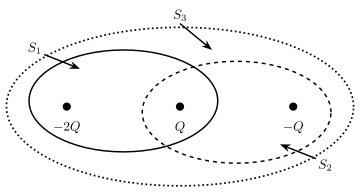 . Match the entries of List-I with that of List-II.
List-I(a) Net flux through S1(b) Net flux through S2(c) Net flux through S3 List-II(i) ϵ0−2Q(ii) ϵ0−Q(iii) Zero (A) a - ii, b - i, c - iii (B) a - iii, b - ii, c - i (C) a - i, b - ii, c - iii (D) a - ii, b - iii, c - i
. Match the entries of List-I with that of List-II.
List-I(a) Net flux through S1(b) Net flux through S2(c) Net flux through S3 List-II(i) ϵ0−2Q(ii) ϵ0−Q(iii) Zero (A) a - ii, b - i, c - iii (B) a - iii, b - ii, c - i (C) a - i, b - ii, c - iii (D) a - ii, b - iii, c - i›Reveal solutionSolution
Gauss's law states that the net electric flux through a closed surface equals Qenc/ϵ0, independent of the position of the charges inside or any charge outside the surface.
Step 1 — Identify the enclosed charge for each surface
From the figure, the three point charges −2Q, Q and −Q are arranged in a line, with S1, S2 and S3 enclosing different combinations of them:
- S1 encloses −2Q and Q, so Qenc,1=−2Q+Q=−Q.
- S2 encloses only Q and −Q, so Qenc,2=Q+(−Q)=0.
- S3 encloses all three charges (−2Q, Q and −Q), so Qenc,3=−2Q+Q+(−Q)=−2Q.
Step 2 — Apply Gauss's law …
- KCET 2025Set D-41 markMCQQ.Which of the following is a correct statement? (A) Gauss's law is true for any open surface (B) Gauss's law is not applicable when charges are not symmetrically distributed over a closed surface. (C) Gauss's law does not hold good for a charge situated outside the Gaussian surface. (D) Gauss's law is true for any closed surface
›Reveal solutionSolution
Gauss's law holds for any closed surface regardless of shape or charge symmetry — symmetry is only a computational convenience — so (D) is the correct statement.
Step 1 — State Gauss's law.
∮SE⋅dS=ε0qenclosed
The surface S must be a closed surface (a Gaussian surface). The law says the net outward flux through it depends only on the total charge enclosed — nothing else.
Step 2 — Test (A): 'true for any open surface'.
The flux integral in Gauss's law is a closed-surface integral (∮). An open surface does not enclose a volume, so 'charge enclosed' is undefined for it. (A) is false.
Step 3 — Test (B): 'not applicable when charges are not symmetrically distributed'.
Gauss's law is a direct consequence of Coulomb's inverse-square law plus the superposition principle; nothing in its derivation assumes symmetry. It is always valid.
Symmetry (spherical, cylindrical, planar) is only what allows us to pull E out of the integral and solve for E easily. Without symmetry the law still holds — it is just no longer a convenient tool for finding E. Confusing 'not useful for calculation' with 'not applicable' is the trap here. (B) is false.
Step 4 — Test (C): 'does not hold good for a charge situated outside the Gaussian surface'. …
- KCET 2025Set D-41 markMCQQ.Given, a current carrying wire of non-uniform cross-section, which of the following is constant throughout the length of wire? (A) Drift speed (B) Current and drift speed (C) Current only (D) Current, electric field and drift speed
›Reveal solutionSolution
Conservation of charge forces the current to be the same everywhere; since I=neAvd with A varying, vd (and E, and J) must change from section to section.
Step 1 — Why the current must be constant: charge conservation.
Consider any portion of the wire between two cross-sections. In the steady state, the amount of charge inside that portion does not change with time (charge is not accumulating anywhere — if it were, the resulting electric field would immediately push it out). Therefore:
charge entering per second=charge leaving per second
⟹Iin=Iout
So the current I has the same value at every cross-section, no matter how the wire's thickness changes. This is just the equation of continuity, and it is the electrical analogue of "what flows into a pipe must flow out".
Step 2 — The microscopic expression for current.
I=neAvd
where n = free-electron density (a property of the material, so constant along a wire of one metal), e = electronic charge (a universal constant), A = cross-sectional area, vd = drift speed.
Step 3 — Deduce how the drift speed behaves.
Rearranging, and using the fact that I, n and e are all constant along the wire:
vd=neAI⟹vd∝A1
So where the wire is narrow (A small), the electrons must drift faster; where it is thick, they drift more slowly. Since the cross-section is stated to be non-uniform, A changes, and therefore vd is not constant.
(Exactly the same intuition as water in a pipe: the flow rate is fixed, so the water speeds up at a constriction.)
Step 4 — What else varies.
The current density is …
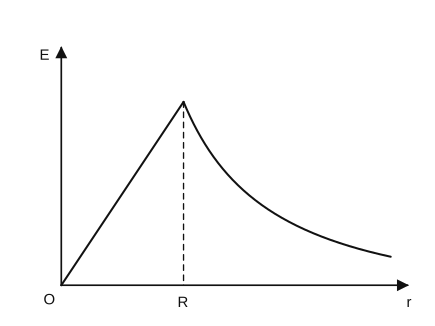
- COMEDK 2025Set 2025-A1 markMCQQ.The electric field versus distance graph is shown as given. Select the correct statement from the following. E- electric field R-radius r - distance from the centre (A) The graph shows the variation of the electric field intensity with distance from the centre of a uniformly charged conducting ring of radius R. (B) The graph shows the variation of the electric field intensity with distance from the centre of a uniformly charged non conducting solid sphere of radius R. (C) The graph shows the variation of the electric field intensity with distance from the centre of a uniformly charged conducting solid sphere of radius R. (D) The graph shows the variation of the electric field intensity with distance from the centre of a uniformly charged non conducting cylinder of radius R.
›Reveal solutionSolution
The graph shows a linear rise inside the object (E ∝ r) up to r = R, then an inverse‑square fall‑off for r > R. This is the signature of a uniformly charged non‑conducting solid sphere, so the correct option is (B).
The key is to match the shape of the graph to the known electric field behaviour of standard charge distributions.
- For a conducting solid sphere, all charge resides on the surface, so inside (r < R) the field is zero — the graph would be flat at zero, not rising linearly.
- For a conducting ring, the field is zero at the centre, rises to a maximum somewhere off‑centre, then decays — but the rise is not linear from the centre, and the maximum is not at r = R.
- For a non‑conducting cylinder, the field inside grows linearly with r only if the cylinder is infinitely long; but the graph shows a clear maximum at r = R and then a decay, which matches a sphere, not a cylinder.
- For a uniformly charged non‑conducting solid sphere, Gauss’s law gives exactly:
- Inside (r < R): E=4πε01R3Qr → linear in r.
- Outside (r > R): E=4πε01r2Q → inverse‑square decay. The maximum occurs at r = R, where the two expressions match.
Let’s walk through the reasoning step by step.
-
Identify the key features of the graph
- At r = 0, E = 0.
- For 0 < r < R, E increases linearly with r (straight line through origin).
- At r = R, E reaches a maximum.
- For r > R, E decreases smoothly, following a curve that decays like 1/r2 (concave up, approaching zero).
-
Recall the electric field for a uniformly charged non‑conducting solid sphere
- By Gauss’s law, for a sphere of radius R with uniform volume charge density ρ:
- Inside (r < R): enclosed charge qenc=ρ⋅34πr3, so
- By Gauss’s law, for a sphere of radius R with uniform volume charge density ρ:
E⋅4πr2=ε0qenc⇒E=3ε0ρr∝r.
- Outside (r > R): total charge $ Q = \rho \cdot \frac{4}{3}\pi R^3 $, soE⋅4πr2=ε0Q⇒E=4πε01r2Q.
- The two expressions match at r = R, giving the maximum field there. This exactly reproduces the graph.
- Eliminate the other options …
- COMEDK 2025Set 2025-E1 markMCQQ.A uniformly charged conducting sphere of 0.2 m diameter has a surface charge density of 70μCm−2. The electric flux leaving the surface of the sphere is: (A) 9.9×10⁵ NC−1 m2 (B) 9.9×10⁶ NC−1 m2 (C) 8.9×10⁵ NC−1 m2 (D) 8.9×10⁶ NC−1 m2
›Reveal solutionSolution
The electric flux leaving a closed surface equals the enclosed charge divided by ε₀ (Gauss’s law). For a sphere with given surface charge density, multiply density by surface area to get total charge, then divide by ε₀. The result is about 9.9×10⁵ NC−1m2, matching option (A).
Concept & Intuition
Gauss’s law is the star here: the total electric flux through any closed surface is simply Qenc/ε0, independent of the shape. For a conducting sphere, all charge resides on its surface. So the “enclosed charge” is just the total charge on the sphere. We’re given surface charge density σ, so we find the sphere’s surface area, multiply to get Q, then apply Gauss’s law. No integration needed — just careful arithmetic.
Step-by-step solution
-
Find the sphere’s radius and surface area
Diameter = 0.2 m → radius r=0.1 m.
Surface area of a sphere: A=4πr2=4π(0.1)2=4π×0.01=0.04π m2.
Numerically, 0.04π≈0.12566 m2.
-
Compute total charge on the sphere
Surface charge density σ=70 μC/m2=70×10−6 C/m2.
Total charge Q=σA=(70×10−6)×(0.04π).
Q=70×10−6×0.04π=2.8×10⁻⁶π C.
Numerically: 2.8×10−6×3.1416≈8.796×10⁻⁶ C.
-
Apply Gauss’s law
Electric flux ΦE=ε0Q, where ε0=8.854×10⁻¹² C2/(Nm2). …
-
- KCET 2024Set D-21 markMCQQ.A uniform electric field E=3×10⁵NC−1 is acting along the positive Y-axis. The electric flux through a rectangle of area 10cm×30cm whose plane is parallel to the Z-X plane is (A) 12×103Vm (B) 9×10³Vm (C) 15×103Vm (D) 18×103Vm
›Reveal solutionSolution
Find the direction of the area vector (normal to the plane), see that it is parallel to E, then use ϕ=E⋅A=EA.
Step 1 — The concept: flux uses the normal, not the plane
Electric flux through a flat area is
ϕ=E⋅A=EAcosθ
where A points perpendicular to the surface and θ is the angle between E and A. The single most common error here is to use the angle between E and the plane instead.
Step 2 — Orient the rectangle
The rectangle's plane is parallel to the Z–X plane. The normal to the Z–X plane is the Y-axis, so
A=Aj^
The field is E=3×10⁵j^ NC−1 — also along j^. Hence θ=0∘ and cosθ=1: the field passes straight through the rectangle, giving maximum flux.
Step 3 — Compute the area in SI units …
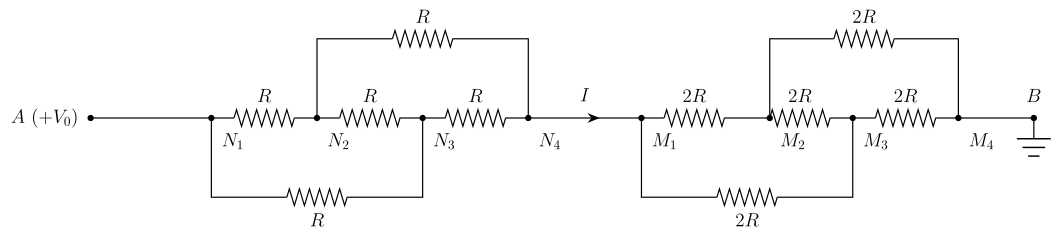
- KCET 2024Set D-21 markMCQQ.In the circuit shown, the end A is at potential V0 and end B is grounded. The electric current I indicated in the circuit is
 (A) RV0
(B) R2V0
(C) R3V0
(D) 3RV0
(A) RV0
(B) R2V0
(C) R3V0
(D) 3RV0›Reveal solutionSolution
Solve each five-resistor half by node/symmetry — each half collapses to a single resistor (R on the left, 2R on the right) — then I=V0/(R+2R)=V0/3R through the single wire joining them.
Step 1 — Write down the left-half network.
Nodes N1 (fed from A) … N4. The five resistors, all of value R, are:
N1−N2,N2−N3,N3−N4 (the main chain),
N2−N4 (top bridging branch),N1−N3 (bottom bridging branch).
Because the two bridging branches overlap (they share the N2−N3 resistor), this is not a simple series–parallel chain — it must be solved by node equations (or symmetry). Trying to "parallel" them piecewise is the trap in this question.
Step 2 — Node analysis for the equivalent resistance N1→N4.
Put V1=V at N1 and V4=0 at N4; let the unknown node potentials be V2,V3.
KCL at N2 (its three resistors go to N1, N3, N4):
RV2−V1+RV2−V3+RV2−V4=0⟹3V2=V1+V3+V4=V+V3.
KCL at N3 (its three resistors go to N2, N1, N4):
RV3−V2+RV3−V1+RV3−V4=0⟹3V3=V2+V+0=V+V2.
Step 3 — Solve.
Subtracting the two equations: 3(V2−V3)=V3−V2⇒4(V2−V3)=0⇒V2=V3.
Substituting back: 3V2=V+V2⇒V2=V3=V/2.
Physical meaning: V2=V3, so no current flows through the middle rung N2−N3 — it is a balanced bridge and that resistor can be deleted. (This is forced by the network's symmetry: swapping N1↔N4 together with N2↔N3 maps the network onto itself.)
Step 4 — Get the current and hence the half's resistance.
Current leaving N1 goes down two paths, N1→N2 and N1→N3:
Ileft=RV−V2+RV−V3=RV/2+RV/2=RV. …
- KCET 2023Set A-31 markMCQQ.A uniform electric field vector E exists along horizontal direction as shown. The electric potential at A is VA. A small point charge q is slowly taken from A to B along the curved path as shown. The potential energy of the charge when it is at point B is (A) q[VA+Ex] (B) q[Ex−VA] (C) qEx (D) q[VA−Ex]
›Reveal solutionSolution
VB=VA−E⋅d=VA−Ex (path-independent), so the potential energy at B is UB=qVB=q[VA−Ex].
Step 1 — Relation between field and potential
For a uniform electric field E, the potential difference between two points separated by displacement d is
VA−VB=E⋅d=Ex,
where x is the component of the A→B displacement along E. The electrostatic field is conservative, so the curved path is irrelevant — only the end points matter.
Step 2 — Potential at B
VB=VA−Ex.
This is just the statement "the potential decreases as you move along the direction of E", by E per unit distance.
Step 3 — Potential energy of the charge at B
By definition, the potential energy of a point charge q at a point of potential V is U=qV. Therefore
UB=qVB=q[VA−Ex].
Step 4 — Check the distractors …
- COMEDK 2023Set 2023-E1 markMCQQ.The electric flux from cube of side 1 m is 'Φ' When the side of the cube is made 3 m and the charge enclosed by the cube is made one third of the original value, then the flux from the bigger cube will be : (A) 3Φ (B) Φ (C) 3Φ (D) 9Φ
›Reveal solutionSolution
New flux = (q/3)/epsilon_0 = (1/3) * (q/epsilon_0) = Phi / 3.
Concept: Gauss's law - the electric flux through a CLOSED surface depends only on the net charge enclosed, not on the size, shape or position of the surface:
Phi = q_enclosed / epsilon_0.
Initially: Phi = q / epsilon_0 (cube of side 1 m). …
🎓Unlock everything free for 14 days
- ✓Full step-by-step solutions
- ✓Concept-first explanations
- ✓Methods, shortcuts & mistakes
- ✓PYQ mapping + timed mock tests
Full access for 14 days. No credit card required.