Q.A short pulse of white light is incident from air to a glass slab at normal incidence. After travelling through the slab, the first colour to emerge is
Concept understanding — Critical Angle Comparison
Critical Angle Comparison: From Intuition to Precision
Imagine you're standing at the edge of a swimming pool, looking down at a coin at the bottom. The coin appears closer to the surface than it actually is. That's refraction — light bends when it moves from water into air. Now imagine tilting your head so you're looking at the coin from a very shallow angle. At some point, the coin suddenly vanishes. You can't see it anymore, no matter how hard you try. That vanishing point is the critical angle.
The Intuition
Light travels at different speeds in different materials. When it crosses from a denser medium (like water or glass) into a rarer medium (like air), it bends away from the normal (the imaginary line perpendicular to the surface). The larger the angle of incidence (the angle at which light hits the boundary), the more it bends away.
At a certain angle of incidence, the refracted ray bends so much that it runs exactly along the surface — it makes a 90° angle with the normal. That's the critical angle. If you increase the angle of incidence even slightly beyond this, the light can't escape at all. It reflects back into the denser medium, a phenomenon called total internal reflection.
Critical angle only exists when light travels from a denser medium to a rarer medium. Going the other way (rarer to denser), light always bends toward the normal — no critical angle, no total internal reflection.
The Precise Statement
The critical angle (θc) is the angle of incidence in the denser medium for which the angle of refraction in the rarer medium is exactly 90°.
Mathematically, from Snell's law:
n1sinθ1=n2sinθ2
Let medium 1 be the denser medium (refractive index n1) and medium 2 be the rarer medium (refractive index n2, with n2<n1). At the critical angle, θ1=θc and θ2=90∘, so sinθ2=1. This gives:
n1sinθc=n2×1
sinθc=n1n2
Where:
- θc = critical angle
- n1 = refractive index of the denser medium
- n2 = refractive index of the rarer medium
What This Tells You
The critical angle depends only on the ratio of the two refractive indices. A larger difference between n1 and n2 means a smaller critical angle — light is more "trapped" inside the denser medium. For example:
| Medium pair | n1 (denser) | n2 (rarer) | θc |
|---|---|---|---|
| Water → Air | 1.33 | 1.00 | ≈48.8∘ |
| Glass → Air | 1.50 | 1.00 | ≈41.8∘ |
| Diamond → Air | 2.42 | 1.00 | ≈24.4∘ |
Diamond's tiny critical angle is why it sparkles so brilliantly — light gets trapped inside and bounces around before escaping.
A common mistake: thinking the critical angle is measured from the surface. It is always measured from the normal (the perpendicular line), just like any other angle in optics.
The Three Regimes
For a given denser-to-rare boundary:
- θ<θc: Refraction occurs — light escapes into the rarer medium, bending away from the normal.
- θ=θc: The refracted ray grazes the surface at 90°.
- θ>θc: Total internal reflection — no light escapes; all of it reflects back into the denser medium.
This is the principle behind optical fibres, where light is kept inside a glass core by repeated total internal reflection, and behind the brilliant sparkle of a cut diamond.
"Critical angle formula total internal reflection" and "critical angle class 12 physics numericals" are commonly searched terms, both drawn from the Ray Optics and Optical Instruments chapter of the NCERT/CBSE Class 12 Physics curriculum. Comparing critical angles across water, glass, and diamond is a classic JEE Main and NEET question.
The key idea is that different colours of light travel at different speeds in glass due to dispersion, with refractive index n decreasing as wavelength increases (red has the smallest n, violet the largest).
- For a given slab thickness t, the time taken by a colour to travel through the slab is t/v, where v=c/n is the speed in glass.
- So the travel time is tn/c — directly proportional to the refractive index n of that colour.
- Since red light has the smallest n in glass, it takes the least time to cross the slab. Violet, with the largest n, takes the longest.
The first colour to emerge is red.
The key idea is that the critical angle for total internal reflection is largest for red light (because refractive index is smallest for red). Since the pulse enters at normal incidence, all colours travel the same path length inside the slab, but the group velocity (energy propagation speed) is highest for red light. Therefore, red emerges first.
Why Critical Angle Comparison Works — The Intuition
When white light enters a glass slab at normal incidence, all colours enter without bending. Inside the slab, each colour travels at a different speed because the refractive index n depends on wavelength — this is dispersion. For typical glass, n is highest for violet (shortest wavelength) and lowest for red (longest wavelength).
The speed of light in the medium is v=c/n. So red, with the smallest n, travels fastest. Over a fixed slab thickness t, the time taken is t/v=nt/c. Since red has the smallest n, it takes the least time and emerges first.
But why bring up the critical angle? Because the critical angle θc is defined by sinθc=1/n (for glass-to-air). A larger n means a smaller θc. So red, with the smallest n, has the largest critical angle. This is a handy mnemonic: the colour that bends least on entering (red) also has the largest critical angle and travels fastest inside the medium. The critical angle comparison is a quick way to rank refractive indices without memorising numbers.
A common mistake is to think that the colour with the largest refractive index (violet) emerges first because it "bends more". But bending only happens at oblique incidence. At normal incidence, there is no bending — only speed matters. The colour with the smallest n (red) is fastest.
Step-by-Step Reasoning
-
Normal incidence means no refraction at the first surface.
When light enters at 0∘ to the normal, Snell's law gives nairsin0∘=nglasssinr, so r=0∘. All colours go straight in along the same path.
-
Inside the slab, each colour travels the same geometric distance — the slab thickness d. But the optical path length is nd, and the actual time taken is t=cnd.
-
Refractive index varies with colour.
For ordinary glass, the dispersion curve is:
- Red: n≈1.51 (lowest)
- Yellow: n≈1.52
- Green: n≈1.53
- Blue: n≈1.54
- Violet: n≈1.55 (highest)
So the time order is: red < yellow < green < blue < violet.
-
Critical angle as a ranking tool.
The critical angle for the glass-air interface is θc=sin−1(1/n). Since n is smallest for red, sin−1(1/n) is largest for red. This gives the same ranking: red has the largest critical angle, hence the smallest n, hence the fastest speed.
-
The first colour to emerge is the fastest.
Therefore, red light exits the slab first.
You don't need to remember exact n values. Just recall the mnemonic: VIBGYOR — Violet has the highest refractive index (slowest), Red has the lowest (fastest). The critical angle is inversely related: larger n → smaller θc.
The first colour to emerge is red.
Method: Ranking Colours by Speed Inside a Medium (Dispersion Problems)
This method solves qualitative ranking questions — which colour of light travels fastest, arrives first, bends most, or has the largest critical angle inside a transparent medium.
Steps
Step 1: Recall how refractive index varies with colour
In ordinary dispersive media (glass, water), refractive index increases as wavelength decreases:
nviolet>nblue>ngreen>nyellow>nred
Step 2: Convert the index ranking into a speed ranking
Since v=c/n, a smaller refractive index means a higher speed inside the medium. This immediately gives the speed order: red fastest, violet slowest.
Step 3: Apply the speed ranking to the specific question being asked
For "who exits/arrives first" over an equal path length inside the medium, the fastest colour (smallest n, i.e. red) wins. For "who bends most on entering", the colour with the largest n (violet) deviates most from the incidence direction.
Step 4 (Applying to this problem): Cross-check with critical angle if the question involves TIR
The critical angle θc=sin−1(1/n) moves the opposite way to n: smaller n gives a larger critical angle. So red has the largest critical angle and violet the smallest — a consistent alternate route to the same colour ranking, useful whenever a problem phrases itself in terms of critical angle instead of speed directly.
- KCET 2026Set C21 markMCQQ.The critical angle for a monochromatic light going from medium A to medium B is θ. If the speed of light in medium A is V, then the speed of light in medium B is (A) V(1−cosθ) (B) cosθV (C) sinθV (D) V(1−sinθ)
›Reveal solutionSolution
At the critical angle, Snell's law with an angle of refraction of 90∘ relates the refractive indices of the two media; converting refractive index to speed using n=c/v gives the required expression.
Step 1 — Apply Snell's law at the critical angle
Light travels from medium A into medium B; at the critical angle θ, the refracted ray grazes the boundary (refraction angle =90∘):
nAsinθ=nBsin90∘=nB⟹nAnB=sinθ
Step 2 — Express refractive indices in terms of speed
Since n=vc, with speed in medium A equal to V and speed in medium B equal to VB:
nAnB=c/Vc/VB=VBV
Step 3 — Solve for the speed in medium B
VBV=sinθ⟹VB=sinθV
✓Final answerThe correct option is (C) — speed in medium B is sinθV.
- KCET 2025Set D-41 markMCQQ.The anode voltage of a photocell is kept fixed. The frequency of the light falling on the cathode is gradually increased. Then the correct graph which shows the variation of photo current I with the frequency ν of incident light is 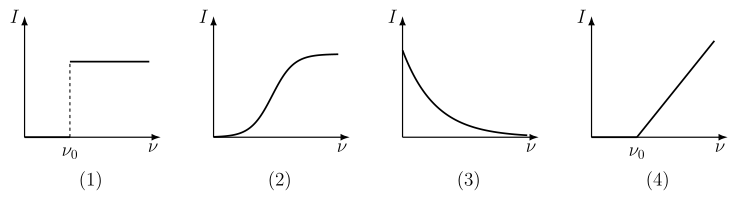 (A) (B) (C) (D)
›Reveal solutionSolution
Below ν0: no emission, I=0. Above ν0: the number of ejected electrons (hence the current) is frequency-independent — a step to a constant value.
Step 1 — Below the threshold frequency.
Einstein's photoelectric equation:
hν=ϕ0+Kmax,ϕ0=hν0.
If ν<ν0 then hν<ϕ0: no photon has enough energy to free an electron, no matter how long you wait or how intense the beam. So
I=0for ν<ν0.
This gives the flat zero portion on the left of the graph.
Step 2 — At and above the threshold frequency.
Emission starts at ν0. The anode voltage is fixed (and positive/large enough to collect the emitted electrons), so we are on the saturation part of the I–V curve: every emitted electron is collected, and
I=nee
where ne is the number of electrons emitted per second. One photon liberates at most one electron, so ne tracks the photon arrival rate, which is set by the intensity of the source — not by the frequency.
Step 3 — Hence the shape.
Increasing ν beyond ν0 gives each electron more kinetic energy (Kmax=h(ν−ν0), which is what changes the stopping potential), but it does not change how many electrons come out. So the photocurrent stays constant for all ν>ν0:
- zero for ν<ν0,
- a sharp step at ν=ν0,
- a horizontal line thereafter.
Step 4 — Eliminate.
(D) a line rising steadily with ν would mean more electrons at higher frequency — contradicts the photon-count argument. (C) a decaying curve implies emission below threshold. (B) has no threshold at all, which is the very feature the photoelectric effect is famous for.
✓Final answerThe correct option is (A) — zero photocurrent up to ν0, then a jump to a constant, frequency-independent value.
ANSWER: A
- KCET 2024Set D-21 markMCQQ.Which of the following combinations should be selected for better tuning of an LCR circuit used for communication? (A) R=20 Ω, L=1.5 H, C=35 μF (B) R=25 Ω, L=2.5 H, C=45 μF (C) R=25 Ω, L=1.5 H, C=45 μF (D) R=15 Ω, L=3.5 H, C=30 μF
›Reveal solutionSolution
"Better tuning" means a sharper, more selective resonance — i.e. the highest quality factor Q=R1L/C. Comparing all four combinations, option (D) has by far the largest Q.
Step 1 — What makes a tuning circuit "better"?
In a series LCR circuit used to tune a receiver to one station's frequency among many crowded nearby frequencies, "good tuning" means a sharp, narrow resonance peak — the circuit should respond strongly at the desired frequency and fall off quickly on either side, rejecting neighbouring stations. This sharpness is quantified by the quality factor:
Q=R1CL=Rω0L
A larger Q means a narrower resonance curve (better selectivity). So among several LCR combinations, the one with the largest Q gives the better tuning. Physically: low resistance wastes less energy (less damping), while a large L/C ratio (big inductance, small capacitance) makes the resonance curve steep.
Step 2 — Compute Q for every option.
Option R (Ω) L (H) C (μF) L/C L/C Q=R1L/C (A) 20 1.5 35 4.29×10⁴ 207.0 10.35 (B) 25 2.5 45 5.56×10⁴ 235.7 9.43 (C) 25 1.5 45 3.33×10⁴ 182.6 7.30 (D) 15 3.5 30 1.167×10⁵ 341.6 22.77 Step 3 — Pick the largest Q.
Option (D) is the clear winner — it is not close. It combines:
- the smallest resistance (15 Ω, vs. 20–25 for the others),
- the largest inductance (3.5 H, vs. 1.5–2.5 for the others),
- one of the smallest capacitances (30 μF, vs. 35–45 for the others).
Every one of these three properties independently pushes Q up, so (D) dominates the comparison — it never needs a trade-off against the other options.
TipYou rarely need the exact numeric Q values on an exam — just check which option has the lowest R and highest L/C ratio simultaneously; that option wins.
✓Final answerThe combination that gives better tuning is (D) — R=15 Ω, L=3.5 H, C=30 μF.
- KCET 2024Set D-21 markMCQQ.Three polaroid sheets are co-axially placed as indicated in the diagram. Pass axes of the polaroids 2 and 3 make 30∘ and 90∘ with pass axis of polaroid sheet 1. If I0 is the intensity of the incident unpolarised light entering sheet 1, the intensity of the emergent light through sheet 3 is (A) Zero (B) 323I0 (C) 83I0 (D) 163I0
›Reveal solutionSolution
Halve the unpolarised intensity at the first polaroid, then apply Malus's law twice using the angles between consecutive pass axes (30∘ then 60∘).
Step 1 — Sheet 1: unpolarised → polarised
Unpolarised light contains all vibration directions equally. A polaroid transmits only the component along its pass axis, and averaging cos2θ over all θ gives 21:
I1=2I0
The light emerging is now linearly polarised along axis 1. (Malus's law does not apply at the first sheet — the incident light has no definite polarisation direction.)
Step 2 — Sheet 2: Malus's law
Malus's law: when light already polarised meets an analyser whose axis makes angle θ with the polarisation direction,
Iout=Iincos2θ
The crucial subtlety: θ is the angle between the incoming polarisation and the next pass axis — not the angle with sheet 1 in every case.
Here the light entering sheet 2 is polarised along axis 1, and axis 2 makes 30∘ with axis 1:
I2=I1cos230∘=2I0(23)2=2I0⋅43=83I0
The light now emerges polarised along axis 2.
Step 3 — Sheet 3: Malus's law again, with the relative angle
Axis 3 makes 90∘ with axis 1, and axis 2 makes 30∘ with axis 1. So the angle between axis 2 and axis 3 is
90∘−30∘=60∘
The light arriving at sheet 3 is polarised along axis 2, so
I3=I2cos260∘=83I0(21)2=83I0⋅41=323I0
Step 4 — Why the answer is not zero
Sheets 1 and 3 are crossed (90∘ apart). With only those two, the output would indeed be zero. But inserting the middle polaroid at an intermediate angle rotates the plane of polarisation in two smaller steps, and light gets through — the celebrated "three-polaroid" result. That is precisely why option (A) "Zero" is the trap.
323I0≈0.094I0
✓Final answerThe correct option is (B) — 323I0.
ANSWER: B
- KCET 2023Set A-31 markMCQQ.A point object is moving at a constant speed of 1 ms−1 along the principal axis of a convex lens of focal length 10 cm. The speed of the image is also 1 ms−1, when the object is at ______ cm from the optic centre of the lens. (A) 15 (B) 20 (C) 5 (D) 10
›Reveal solutionSolution
Along the axis the image speed is vi=m2vo, where m is the lateral magnification. Equal speeds (vi=vo) require m2=1, i.e. ∣m∣=1, which for a convex lens occurs at object distance u=2f=20cm - option (B).
Concept: longitudinal (axial) magnification
Differentiating the lens equation shows that for motion along the principal axis
vi=m2vo,m=uv (lateral magnification).
Setting vi=vo=1m s−1 gives m2=1, so ∣m∣=1.
Where ∣m∣=1 for a convex lens
For a convex lens a same-size (real, inverted, m=−1) image forms when the object is at 2f. With f=10cm,
u=2f=20cm.
Check with v1−u1=f1 using u=−20cm, f=+10cm:
v1=101+−201=201⇒v=+20cm,m=uv=−1,
so m2=1 and vi=vo.
✓Final answerThe object is at 2f=20cm from the optic centre - option (B).
- COMEDK 2023Set 2023-E1 markMCQQ.The critical angle of a medium having the refractive index 2 is : (A) 30∘ (B) 45∘ (C) 60∘ (D) 90∘
›Reveal solutionSolution
n = sqrt2, so sin C = 1/sqrt2 = 0.707 C = 45 degrees.
Concept: critical angle for total internal reflection, sin C = 1/n (light going from the denser medium into air).
n = sqrt2, so
sin C = 1/sqrt2 = 0.707
C = 45 degrees.
✓Final answerThe correct option is (B) — 45∘
ANSWER: B
- KCET 2022Set B-31 markMCQQ.Which of the following radiations of electromagnetic waves has the highest wavelength? (A) IR-rays (B) Microwaves (C) X-rays (D) UV-rays
›Reveal solutionSolution
Order the four radiations on the EM spectrum; microwaves lie farthest from the γ/X-ray end, so they have the largest wavelength.
1. The concept
All electromagnetic waves travel at c=3×10⁸ m s−1 in vacuum, and
c=νλ⟹λ=νc
so wavelength is inversely proportional to frequency (and to photon energy E=hν). Ranking by wavelength is therefore the reverse of ranking by energy.
2. Place the four options
Radiation Typical wavelength Typical frequency X-rays 10−11 – 10−9 m ∼1016–1019 Hz UV-rays 10−8 – 4×10⁻⁷ m ∼1015–1017 Hz IR-rays 7×10⁻⁷ – 10−3 m ∼1011–1014 Hz Microwaves 10−3 – 0.3 m ∼109–1011 Hz 3. Sort them
λX-ray<λUV<λIR<λmicrowave
Microwaves have the lowest frequency of the four, and by λ=c/ν that means the highest wavelength.
(Note IR is the runner-up — the two bands actually meet around 1 mm, but the microwave band extends well beyond that into the centimetre range.)
✓Final answerThe correct option is (B) — Microwaves.
ANSWER: B
- KCET 2021Set B-21 markMCQQ.The size of the image of an object, which is at infinity, as formed by a convex lens of focal length 30cm is 2cm. If a concave lens of focal length 20cm is placed between the convex lens and the image at a distance of 26cm from the lens, the new size of the image is (A) 1.25cm (B) 2.5cm (C) 1.05cm (D) 2cm
›Reveal solutionSolution
The convex lens's image becomes a virtual object 4 cm behind the concave lens; apply v1−u1=f1 with u=+4 cm to get m=1.25, so the 2 cm image grows to 2.5 cm.
1. Locate the image formed by the convex lens alone
The object is at infinity, so the convex lens forms its image exactly at the focal plane:
v1=f1=30 cm (to the right of the convex lens)
That image is 2 cm tall (given).
2. Where does the concave lens sit?
The concave lens is placed 26 cm from the convex lens, i.e. between the convex lens and the image.
distance from concave lens to that image=30−26=4 cm (on the far side, to the right)
3. The key idea — a VIRTUAL OBJECT
The converging rays are intercepted by the concave lens before they can meet. They are heading for a point 4 cm behind (to the right of) the concave lens. For the concave lens, this point is a virtual object.
With the Cartesian sign convention (light travels left → right, distances measured from the lens, rightward positive):
u=+4 cm (positive—the object is on the OUTGOING side),f2=−20 cm (concave)
This positive u is the whole trick of the problem — a real object would give a negative u.
4. Apply the thin-lens equation to the concave lens
v1−u1=f1
v1=f1+u1=−201++41
v1=20−1+205=204=51
v=+5 cm
So the final image forms 5 cm to the right of the concave lens — a real image (positive v), pushed further out than the original 4 cm, exactly as a diverging lens should do to converging light.
5. Magnification and the new size
m=uv=+4+5=1.25
hnew=m×hold=1.25×2 cm=2.5 cm
6. Sanity check
The concave lens diverges the converging beam, so the rays cross the axis further away (5 cm>4 cm) and, having travelled further from the axis-crossing geometry, the image is magnified (∣m∣=1.25>1). An enlargement to 2.5 cm is exactly what we expect — this is the working principle of the telephoto lens. ✓
(Option (A), 1.25 cm, is the magnification itself mistaken for the size; option (D), 2 cm, is the answer if you forget the concave lens does anything.)
✓Final answerThe correct option is (B) — 2.5 cm.
ANSWER: B
- KCET 2019Set A-11 markMCQQ.An aluminium sphere is dipped into water. Which of the following is true? (A) Buoyancy will be less in water at 0°C than that in water at 4°C (B) Buoyancy will be more in water at 0°C than that in water at 4°C (C) Buoyancy in water at 0°C will be same as that in water at 4°C (D) Buoyancy may be more or less in water at 4°C depending on the radius of the sphere
›Reveal solutionSolution
Upthrust ∝ density of the liquid, and water is densest at 4∘C — so the buoyant force is greater at 4∘C than at 0∘C.
Step 1 — Archimedes' principle
The buoyant force on a fully submerged body is the weight of the liquid it displaces:
FB=ρliquidVdisplacedg
For a fully-dipped sphere, Vdisplaced=Vsphere. So FB depends on the density of the water, the sphere's volume, and g — nothing else. In particular it does not depend on the sphere's own density or material.
Step 2 — The anomalous expansion of water
Water is unusual: on warming from 0∘C to 4∘C it contracts rather than expands, and only above 4∘C does it expand normally. Hence its density peaks at 4∘C:
ρ4∘C=1000.0 kg/m3>ρ0∘C≈999.8 kg/m3
(This is precisely why lakes freeze from the top down and fish survive beneath the ice.)
Step 3 — Compare the two cases
FB(4∘C)FB(0∘C)=ρ4∘V4∘ρ0∘V0∘
The aluminium sphere's volume changes only through its own (very small) thermal expansion over a 4∘C interval — a relative change of order αVΔT≈(7×10⁻⁵)(4)≈3×10⁻⁴, i.e. negligible and, if anything, it makes the sphere smaller at 0∘C too. The dominant effect is the water's density.
Since ρ0∘<ρ4∘:
FB(0∘C)<FB(4∘C)
Step 4 — Screen the options
- (A) Buoyancy less at 0∘C than at 4∘C — correct, this is exactly what ρ0∘<ρ4∘ gives.
- (B) The reverse — wrong; it would require water to be densest at 0∘C.
- (C) "Same" — wrong; it ignores the anomalous expansion entirely.
- (D) Radius-dependent — wrong; FB∝V scales both cases identically, so the ratio is independent of radius. Buoyancy is always larger at 4∘C, whatever the size.
✓Final answerThe correct option is (A) — buoyancy will be less in water at 0∘C than that in water at 4∘C, because water is densest at 4∘C.
ANSWER: A
🎓Unlock everything free for 14 days
- ✓Full step-by-step solutions
- ✓Concept-first explanations
- ✓Methods, shortcuts & mistakes
- ✓PYQ mapping + timed mock tests
Full access for 14 days. No credit card required.