Mathematics and Statistics · Ch 2 — Functions
Exponential and Logarithmic Functions
Exponential and Logarithmic Functions
Two further standard functions, of central importance in commercial mathematics (compound growth, present value, depreciation), are the exponential and logarithmic functions. They are inverses of one another, so it is natural to study them together.
Exponential function. For a fixed base , , the exponential function is
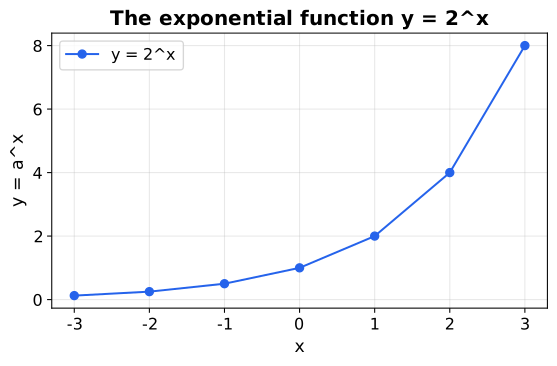
Its domain is the whole of and its range is — an exponential is always strictly positive and never touches the -axis. Every exponential graph passes through , since . It is strictly increasing when (growth) and strictly decreasing when (decay); in either case it is one-one. The special base gives the natural exponential , used throughout continuous-growth models.
Logarithmic function. For the same base , , the logarithmic function is
and is defined by the equivalence — it answers the question "to what power must be raised to give ?" Its domain is (the logarithm of zero or of a negative number is undefined) and its range is the whole of . Every logarithmic graph passes through , since . …
with , ; domain , range . It passes through , is increasing if and …
with , , ; domain , range . Defined by ; it is the inverse of …
; ; — v …