Mathematics and Statistics · Ch 2 — Functions
Standard Functions and Their Algebraic Forms
Standard Functions and Their Algebraic Forms
The syllabus expects familiarity with a catalogue of standard functions, each identified by its algebraic form, its domain, its range and its graph shape.
Constant function: for a fixed real , whatever the value of . Domain , range ; its graph is a horizontal straight line at height . It is many-one (unless the domain has one element) and into.
Identity function: . Domain and range both ; its graph is the line through the origin at . It is bijective on .
Polynomial function: , where the coefficients are real and is a non-negative integer. Its domain is always the whole of . Constant (), linear () and quadratic , () are the simplest cases. A non-zero-slope linear function is bijective; a quadratic over all of is always many-one, since the two sides of its parabola repeat every output except at the vertex.
Rational function: a ratio of two polynomials, , defined wherever . Its domain always excludes every root of .
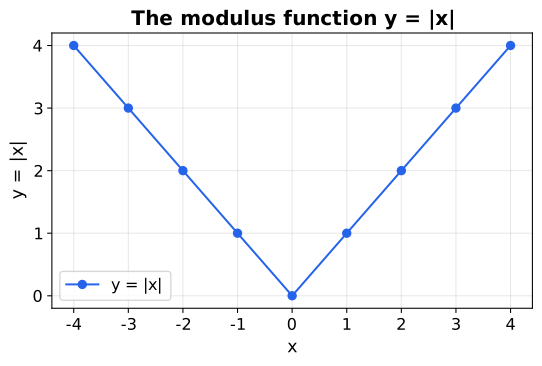
Modulus (absolute value) function: , defined piecewise as when and when . Domain , range — it is never negative; its graph is a "V" with vertex at the origin. It is an even function.
Signum function: , defined as when , when , and when . Domain , range ; its graph is two horizontal rays at heights and with a single point at the origin. It reports only the sign of its input. …
A polynomial function is defined for all real . A rational function is a ratio of polynomials, defined for all real …
, equal to for and for ; domain , range . Its graph is a V with vertex at the origin, a …
equals for , for and for ; range . It reports o …
is the greatest integer ; e.g. , . Domain , range ; a step graph closed on the left, open …