Mathematics and Statistics · Ch 2 — Functions
Inverse Functions and Graphs
Inverse Functions and Graphs
If is bijective (Section 2), then for every there is exactly one with . This lets us define a new function, the inverse function , by
In effect reverses every ordered pair of : if , then . An inverse "undoes" what the original function does, in the precise sense that
Only a bijective function is guaranteed to have an inverse that is itself a function — this is exactly why bijectivity was singled out in Section 2. (A function that is one-one but not onto can be made invertible by restricting its codomain to its range.)
To find the inverse of a function given by a formula :
- Write .
- Solve this equation algebraically for in terms of .
- Interchange the roles of the variables, writing for the resulting expression (relabelling as ).
- State the domain of , which is the range of .
Graphs and inverses. The graph of is always the mirror image of the graph of in the line — reflecting each point to . This is why the exponential graph and the logarithmic graph of the same base are reflections of one another.
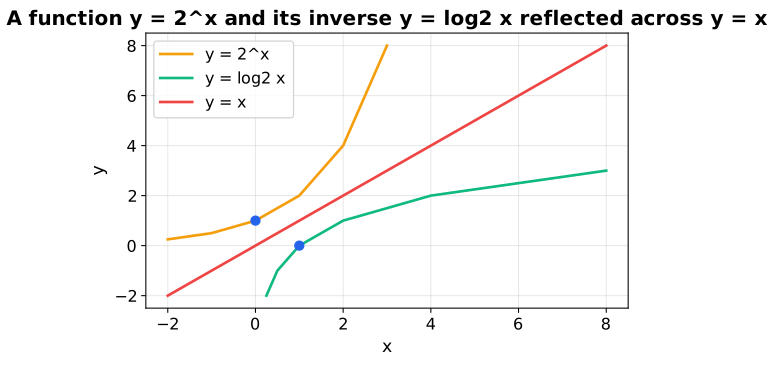
If is bijective, its inverse satisfies and . Found by writing and solvin …
The graph of is the reflection of the graph of in the line : each point $(a,b) …
A function is one-one (and hence invertible on its range) if and only if no horizontal line meets its graph at …