Biology · Ch 5 — Origin and Evolution of Life
Types of Natural Selection
Types of Natural Selection
Type of Natural selection :
a. Stabilizing selection (Balancing selection) :
- Here more individuals of a population acquire the mean character value.
- It tends to favour the intermediate forms and eliminate both the phenotypic extremes, e.g. more infants of intermediate weight survive than those who are over-weight or under-weight.
- It reduces variation.
- It does not lead to evolutionary change but tends to maintain phenotypic stability within the population; therefore it is described as stabilizing selection.
- Genetically, stabilizing selection represents a situation where a population is adapted to its environment.
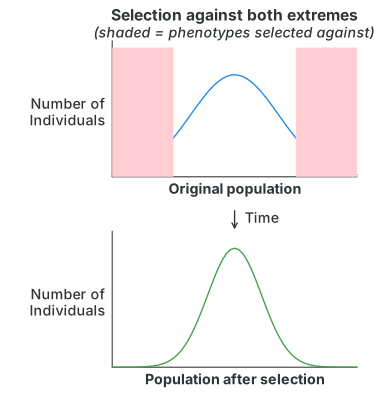
Drawn by us to help you understand the concept clearly, and verified to make sure it's accurate. For exams, practice from your textbook's own diagram.
What this figure shows. A pair of population distribution curves plotted against a trait value, drawn one above the other across time, in which the later 'population after selection' curve is narrower and more sharply peaked around the same central value as the earlier 'original population' curve, with shading marking that both tails (extremes) of the distribution have been selected against, leaving the intermediate, …
b. Directional selection :
- In this type more individuals acquire a value other than the mean character value.
- Natural selection acts to eliminate one of the extremes of the phenotypic range and favour the other, e.g. the systematic elimination of homozygous recessives.
- Directional selection operating for many generations results in an evolutionary trend within the population and a shifting of the peak in one direction.
- Examples - industrial melanism, DDT-resistant mosquitoes.
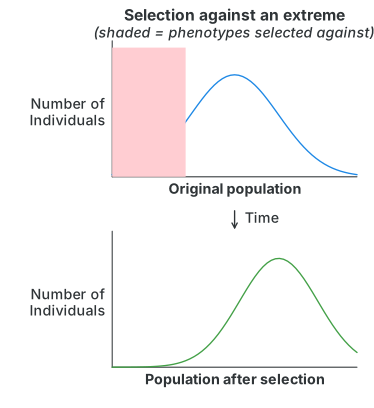
Drawn by us to help you understand the concept clearly, and verified to make sure it's accurate. For exams, practice from your textbook's own diagram.
What this figure shows. A pair of population distribution curves plotted against a trait value across time, where the later 'population after selection' curve has visibly shifted sideways compared with the earlier 'original population' curve, with shading marking that one entire extreme of the distribution has been selected against while the opposite extreme has been favoured, so the whole population's avera …
c. Disruptive natural selection :
- Here more individuals acquire peripheral character values at both ends of the distribution curve.
- Nature selects the extreme phenotypes and eliminates the intermediate ones; hence two peaks are formed in the distribution of traits.
- This kind of selection is rare.
- It affects the entire gene pool of a population, considering all mating types or systems.
- Example - the different beak sizes of the African seed-cracker finches. The available seeds were of two kinds, small and large; large-beaked birds fed on large seeds and small-beaked birds on small seeds, and their numbers increased, while birds with intermediate beaks could feed on neither kind, so their population decreased gradually and was eliminated by natural selection.
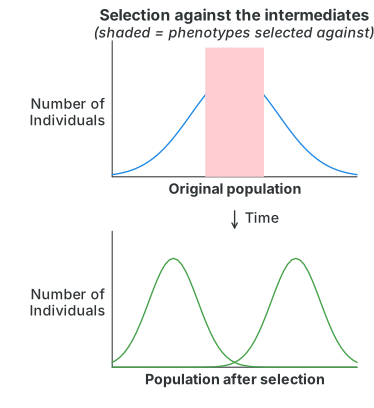
Drawn by us to help you understand the concept clearly, and verified to make sure it's accurate. For exams, practice from your textbook's own diagram.
What this figure shows. A pair of population distribution curves plotted against a trait value across time, where the earlier 'original population' shows one central peak but the later 'population after selection' curve has split into two separate peaks on either side of the original centre, with shading marking that the intermediate trait values have been selected against while both extremes have …
A number of factors — gene migration (gene flow), genetic drift, mutation, genetic recombination, natural selection and non-random mating among them — can disturb the Hardy-Weinberg equilibrium of a population. Conversely, if none of these disturbing factors is acting on a population, that population is said to be genetically stable, or non-evolving. …