Chemistry · Ch 11 — Alcohols, Phenols and Ethers
Chemical properties of ethers
Chemical properties of ethers
Ethers are largely, though not entirely, chemically unreactive. As a laboratory test, ethers do not react with bases, cold dilute acids, reducing agents, oxidising agents, or active metals -- but they DO dissolve in cold concentrated H2SO4, because the ether oxygen's lone pair is protonated to form a water-soluble oxonium salt; this dissolution behaviour is specifically what distinguishes an ether from a hydrocarbon in the laboratory, since a hydrocarbon (having no oxygen at all) cannot form an analogous salt. Reactions involving the alkyl group of an ether include two genuinely important ones. Peroxide formation: on prolonged exposure to atmospheric oxygen, ethers slowly form a peroxide at the carbon next to the ether oxygen; this is a serious practical hazard, because such peroxides can decompose violently (explosively) on heating, which is exactly why ethers are always stored in airtight, brown (light-excluding) bottles -- both air and light drive the peroxide-forming reaction, so excluding both is the standard safety precaution. Cleavage reactions: with PCl5, an ether is split into two alkyl chlorides plus phosphorus oxychloride on heating; with hot, concentrated hydrogen halides (reactivity order HI > HBr > HCl), a dialkyl ether is cleaved to an alcohol plus an alkyl halide, and using an EXCESS of the hydrogen halide converts that alcohol product further into a second alkyl halide -- mechanistically, protonation of the ether oxygen forms an oxonium ion, which the halide ion then attacks by SN2 at whichever carbon is LESS hindered (so a methyl-ethyl ether with hot HI gives methyl iodide plus ethanol, not ethyl iodide plus methanol), except that an ether bearing a tertiary alkyl group instead reacts by an SN1 pathway, giving the tertiary alkyl IODIDE rather than the tertiary alcohol; an aryl alkyl ether such as anisole cleaves specifically at its oxygen-ALKYL bond (never the stronger, shorter oxygen-aryl bond), so anisole with hot HI gives phenol plus methyl iodide, never iodobenzene. Aromatic ethers additionally undergo electrophilic aromatic substitution on their ring, since the alkoxy (-OR) group is ring-activating and ortho-/para-directing by the same resonance (+R) mechanism as phenol's -OH: anisole, for instance, brominates in acetic acid even without a Le …
What this figure shows. Ethers are neutral, largely unreactive compounds in water -- they do not react with bases, cold dilute acids, reducing agents, oxidising agents, or active metals. They do, however, dissolve in cold concentrated H2SO4, because the ether oxygen's lone pair is protonated to form a water-soluble oxonium salt (R-O-R' + H2SO4 -> [R-O+H-R'] HSO4(-)); this dissolution behaviour is the property used to distinguish ethers from hydrocarbons in the laboratory, since hydrocarbons do not dissolve in cold c …
What this figure shows. Ethers combine with atmospheric oxygen on long standing in contact with air to form a hazardous peroxide: diethyl ether, for example, is oxidised at the alpha C-H (the carbon next to the ether oxygen) to give a hydroperoxide, CH3-CH(OOH)-O-C2H5. Every ether sample that has been exposed to air is assumed to contain some peroxide, and this is a genuinely dangerous property because ether peroxides decompose violently (explosively) on heating -- which is exactly why ethers must be stored in airtight, brown (light-excluding) bottles …
Drawn by us to help you understand the concept clearly, and verified to make sure it's accurate. For exams, practice from your textbook's own diagram.
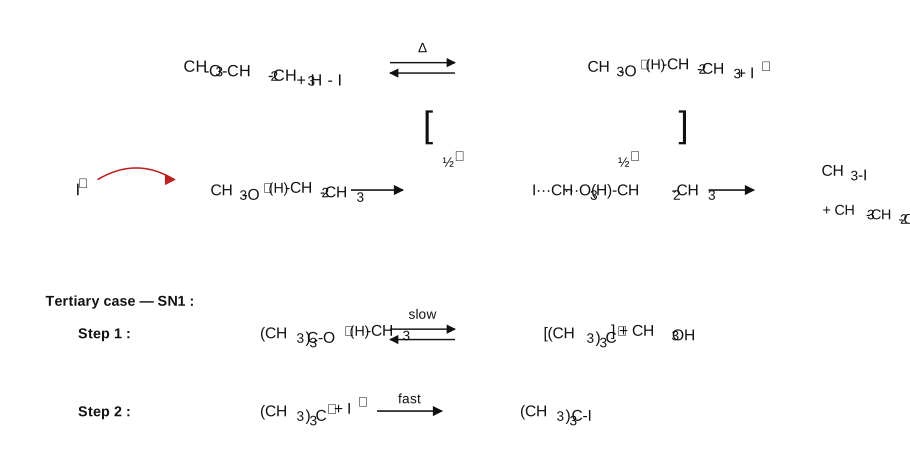
What this figure shows. Two cleavage reactions of the C-O bond. With PCl5: an ether reacts with phosphorus pentachloride, on heating, to give two alkyl chlorides plus phosphorus oxychloride (R-O-R' + PCl5 -> R-Cl + R'-Cl + POCl3). With hot concentrated hydrogen halides (reactivity order HI > HBr > HCl): a dialkyl ether cleaves to an alcohol plus an alkyl halide (R-O-R' + HX -> R-X + R'-OH), and if excess HX is used the alcohol product is itself further converted to the alkyl halide (R-OH + HX -> R-X + H2O). Mechanism (a Do-you-know box) for a mixed methyl-ethyl ether with hot HI: protonation of the ether oxygen forms an oxonium ion; the small nucleophile I(-) then attacks the LESS substituted (least hindered) carbon of the oxonium ion in an SN2 step, so CH3-O-CH2-CH3 gives CH3-I plus CH3-CH2-OH (methyl iodide, not ethyl iodide, since I(-) attacks the methyl carbon). Separately, an ether bearing one tertiary alkyl group reacts with hot HI by an SN1 pathway instead: (CH3)3C-O-CH3 first slowly ionises to the stable tertiary carbocation (CH3)3C+ plus methanol, …
Drawn by us to help you understand the concept clearly, and verified to make sure it's accurate. For exams, practice from your textbook's own diagram.
What this figure shows. An aryl alkyl ether such as anisole (methoxybenzene) reacts with HI, on heating (398 K), by cleavage specifically at the oxygen-ALKYL bond rather than the oxygen-aryl bond -- because the aryl-oxygen bond is shorter and stronger (partial double-bond character from ring conjugation) than the alkyl-oxygen bond -- giving phenol plus methyl iodide (C6H5-O-CH3 + HI -> C6H5-OH + CH3I), never iodobenzene. This is the reaction reference …
Drawn by us to help you understand the concept clearly, and verified to make sure it's accurate. For exams, practice from your textbook's own diagram.
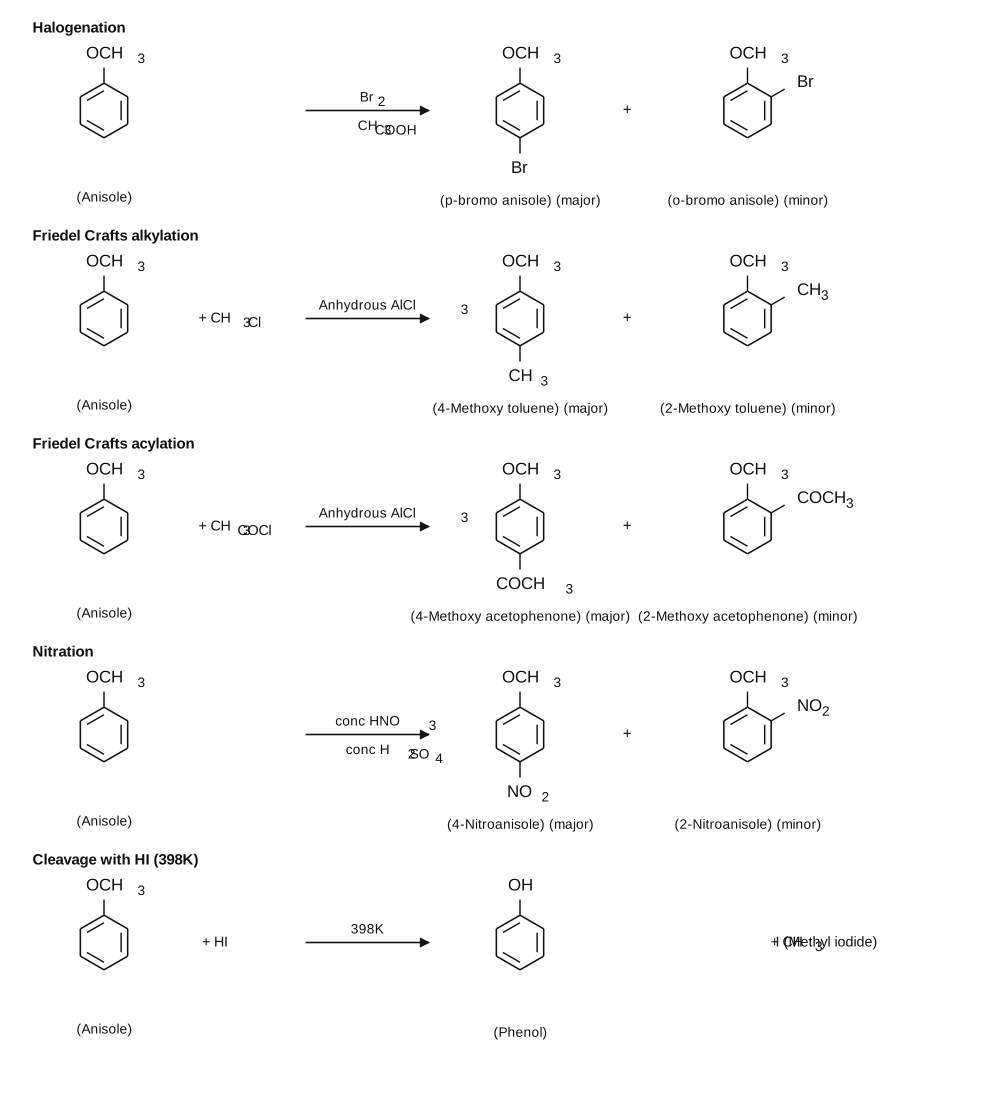
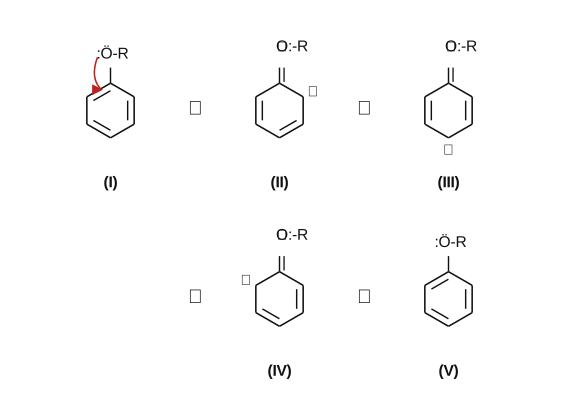
What this figure shows. The alkoxy (-OR) group on an aromatic ether is ring-activating and ortho-/para-directing toward electrophilic aromatic substitution, exactly like the -OH of phenol, through the same +R (resonance electron-donation) effect: the oxygen's lone pair delocalises into the ring, raising electron density specifically at the ortho and para ring carbons (shown by the ether-oxygen resonance structures). Three worked reaction families on anisole (methoxybenzene) illustrate this: (i) Halogenation -- anisole brominates with Br2 in acetic acid even WITHOUT a FeBr3 catalyst (unlike plain benzene, which needs one), because the methoxy group's ring-activation is strong enough on its own; the major product is p-bromoanisole, with o-bromoanisole as the minor product. (ii) Friedel-Crafts reaction -- anisole reacts with an alkyl halide (e.g. CH3Cl) or an acyl chloride (e.g. CH3COCl) in the presence of anhydrous AlCl3 (a Lewis-acid catalyst) to give, respectively, 4-methoxytoluene (major)/2-methoxytoluene (minor), or 4-methoxyacetophenone (major)/2-methoxyacetophenone (minor). (iii) Nitration -- anisole with the nitrating mixture (concentrated HNO3 + concentrated H2SO4) gives a mixture of 4-nitroanisole (major) and 2-nitroanisole (minor). In every case th …