Chemistry · Ch 11 — Alcohols, Phenols and Ethers
Physical properties
Physical properties
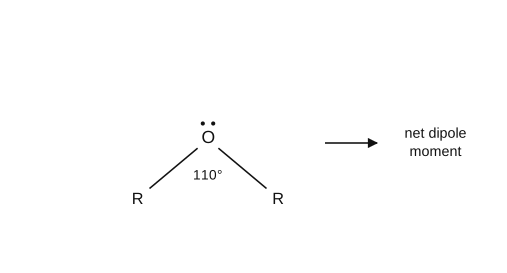
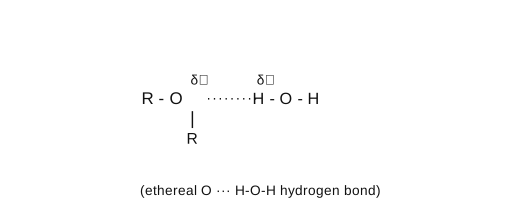
Ethers' physical state and boiling points follow a clear pattern by size: the two smallest ethers, dimethyl ether and ethyl methyl ether, are gases at room temperature, while all larger ethers are colourless, highly volatile, highly flammable liquids with a pleasant, characteristic odour; within this liquid range, boiling points rise gradually and steadily as molecular mass increases (e.g. CH3-O-CH3 at 248 K, C2H5-O-CH3 at 284 K, C2H5-O-C2H5 at 308 K). Regarding polarity: because an ether's C-O-C bond angle is roughly 110 degrees rather than a linear 180 degrees, the two individual C-O bond dipoles do not cancel, and an ether therefore possesses a small net molecular dipole moment (1.18 D for diethyl ether, as an example) -- but this polarity is weak enough that it does not noticeably affect ethers' boiling points, which instead sit close to those of alkanes of comparable molecular mass (Table 11.6: n-heptane, methyl n-pentyl ether and n-hexyl alcohol all have essentially the same molecular mass of about 100-102, yet the ether's boiling point, 373 K, sits close to the alkane's 371 K, while the alcohol's is far higher at 430 K) -- the underlying reason being that, unlike alcohols, ether molecules cannot hydrogen-bond to EACH OTHER, since there is no O-H present anywhere in an ether. Despite this, ethers' SOLUBILITY in water is nonetheless comparable to that of alcohols of similar molecular mass, because the ether's oxygen atom, even without an O …
Ether | B.P. (K): CH3-O-CH3 (dimethyl ether) | 248. C2H5-O-CH3 (ethyl methyl ether) | 284. C2H5-O-C2H5 (diethyl ether) | 308. (Illustrates the gradual, monotonic rise in boiling point as molecular mass increases across t …
Drawn by us to help you understand the concept clearly, and verified to make sure it's accurate. For exams, practice from your textbook's own diagram.
What this figure shows. An ether's C-O-C bond angle is about 110 degrees rather than the 180 degrees a linear arrangement would give, so the two individual C-O bond dipole moments do NOT cancel each other out; the two bond dipoles instead add (vectorially) to a small net molecular dipole moment -- for example, diethyl ether has a dipole moment of 1.18 D. This net polarity is described as weak, however: it is not strong enough to noticeably raise ethers' boiling points abov …
Name | Molecular mass | Boiling point (K): n-Heptane | 100 | 371. Methyl n-pentyl ether | 102 | 373. n-Hexyl alcohol | 102 | 430. (Shows that, despite having almost identical molecular mass, the ether's boiling point sits close to the non-polar alkane's -- since neither can hydrogen-bond between its own molecules -- while the alcohol's boiling point is far higher, reflecting t …
Drawn by us to help you understand the concept clearly, and verified to make sure it's accurate. For exams, practice from your textbook's own diagram.
What this figure shows. Although ether molecules cannot hydrogen-bond to EACH OTHER (no O-H present) the way alcohols do, an ether's oxygen lone pairs can still accept a hydrogen bond FROM a water molecule's O-H (R-O(delta-): ...H-O-H, ether oxygen as hydrogen-bond acceptor), which is why ethers remain about as water-soluble as alcohols of comparable molecular mass -- diethyl ether dissolves 7.5 g and n-butyl alcohol 9 g per 100 g of water, a similar order of magnitude despite the very different int …