Chemistry · Ch 11 — Alcohols, Phenols and Ethers
Preparation of ethers
Preparation of ethers
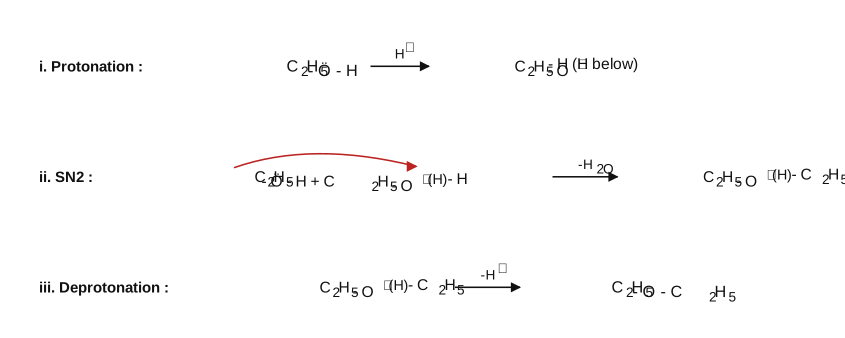
Ethers can be made by two general routes. The first is acid-catalysed dehydration of an alcohol using a dehydrating agent such as concentrated H2SO4 or H3PO4, where the SAME alcohol can give EITHER an ether or an alkene depending purely on the temperature used -- for instance ethanol with H2SO4 gives diethyl ether (ethoxyethane) at 413 K but ethene at the higher temperature of 443 K; mechanistically this ether-forming pathway is an SN2 reaction, in which one alcohol molecule is first protonated at its oxygen, and a second molecule of the same alcohol then attacks that protonated carbon from the back side before a final deprotonation gives the neutral ether. This dehydration route works well only for PRIMARY alcohols and gives SYMMETRICAL ethers; a higher reaction temperature, or a secondary/tertiary starting alcohol, instead favours the competing elimination pathway to an alkene. The second, more versatile route is the Williamson synthesis, which can make both symmetrical and mixed (unsymmetrical) ethers in the laboratory: an alkyl halide is treated with a sodium alkoxide or sodium phenoxide, and the alkoxide/phenoxide ion (a nucleophile) attacks the alkyl halide's carbon from the back side in an SN2 mechanism, displacing the halide and forming the new C-O bond of the ether. Because it proceeds by SN2, the alkyl halide used in a Williamson synthesis MUST be primary -- a secondary or, especially, a tertiary alkyl halide instead reacts mainly by elimination, giving an alkene as the major product, since the bulky alkoxide is forced to act as a base rather than as a nucleophile toward the hindered carbon -- and aryl halides cannot undergo Williamson synthesis at all, since the aryl-halogen bond structurally resists SN2 attack. This constraint means the CHOICE of which fragment supplies th …
Drawn by us to help you understand the concept clearly, and verified to make sure it's accurate. For exams, practice from your textbook's own diagram.
What this figure shows. Heating an alcohol with a dehydrating agent (concentrated H2SO4 or H3PO4) can give either an ether or an alkene, depending on temperature: ethanol at 413 K with H2SO4 gives ethoxyethane (diethyl ether), while the same ethanol at the higher temperature of 443 K instead gives ethene. This ether-forming route works well only for primary alcohols and gives symmetrical ethers; using a higher temperature, or a secondary/tertiary alcohol, favours the competing alkene-forming elimination instead. Mechanism (a Do-you-know box): (i) protonation of one alcohol molecule's -OH by H+ gives a protonated alcohol (C2H5-O+H2); (ii) a second molecule of the same alcohol then attacks the protonated carbon from the back side in a slow SN2 step, displacing water and forming a protonated ether intermediate; (iii) fast deprotonation of th …
Drawn by us to help you understand the concept clearly, and verified to make sure it's accurate. For exams, practice from your textbook's own diagram.
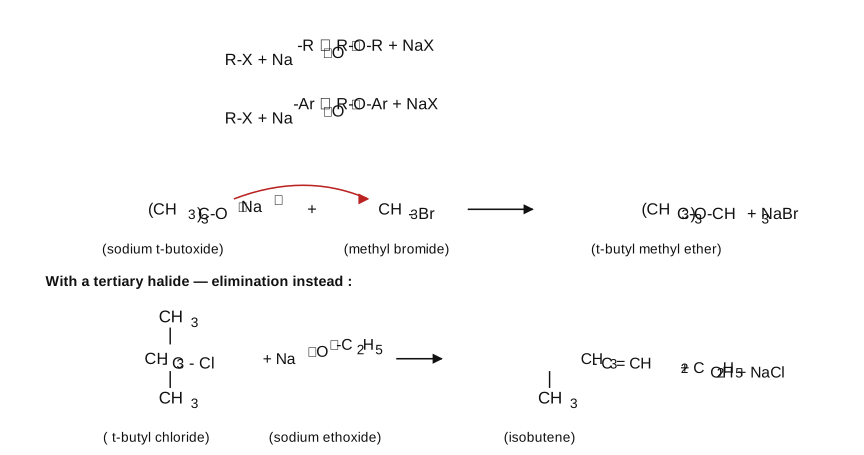
What this figure shows. An alkyl halide (R-X) is treated with a sodium alkoxide (Na+ -O-R) or sodium phenoxide (Na+ -O-Ar) to give a dialkyl ether (R-O-R) or an alkyl aryl ether (R-O-Ar) plus NaX, via an SN2 mechanism in which the alkoxide/phenoxide (a nucleophile) attacks the alkyl halide's carbon from the back side. Because it is an SN2 reaction, the alkyl halide used MUST be primary (using a secondary or tertiary alkyl halide instead gives mainly elimination -- alkene formation -- since the bulky nucleophile is forced to act as a base rather than attack the hindered carbon); aryl halides never undergo Williamson synthesis at all, since aryl-halogen bonds resist SN2 substitution. Worked example: t-butyl methyl ether is made from methyl bromide (the required primary/small halide) plus sodium tert-butoxide -- (C …
Worked out. In-text exercise box illustrating that both reagents needed for a Williamson synthesis (an alkoxide/phenoxide nucleophile and an alkyl halide) can themselves be derived from the SAME starting hydroxy compound: e.g. ethanol (C2H5-OH) can be converted to sodium ethoxide (C2H5-O-Na, with Na metal) to serve as the nucleophile, or to ethyl halide (C2H5-X, with HX) to serve as the electrophile; likewise phenol can be converted to sodium phenoxide with NaOH. This underlines that Williamson synthesis is fundamentally a way of joining two hydroxy-compound-derived fragments through a new C-O b …
What this figure shows. When a secondary or tertiary alkyl halide is used instead of a primary one in an attempted Williamson synthesis, the bulky alkoxide/phenoxide nucleophile instead acts as a base, giving mainly the elimination (alkene) product. Worked example: t-butyl chloride, (CH3)3C-Cl, treated with sodium ethoxide (Na+ -OC2H5) gives isobutene [(CH3)2C=CH2] as the major product, plus ethanol and NaCl, rather than the intended t-butyl ethyl eth …
Worked out. Worked example: sodium ethoxide plus isopropyl chloride does NOT give ethyl isopropyl ether as expected. (i) What is the main product? (ii) Suggest another route to ethyl isopropyl ether. Solution: (i) isopropyl chloride is a secondary halide, so treating it with sodium ethoxide instead gives an elimination reaction, forming propene (CH3-CH=CH2) as the main product, along with ethanol and NaCl. (ii) Ethyl isopropyl ether can instead be made correctly by using the PRIMARY halide as the electrophile and the secondary alkoxide as the nucleophile: ethyl chloride (C2H5-Cl, a primary/10 halide) reacted with sodium isopropoxide [(CH3)2CH-O-Na] gives ethyl isopropyl ether [C2H5-O-CH(CH3)2] plus NaCl, since the SN2 attack now …