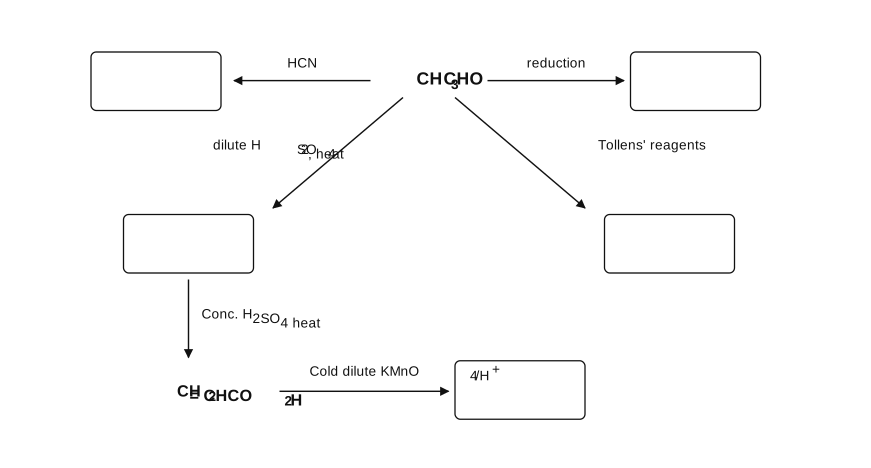
Q.Draw and complete the following reaction scheme which starts with acetaldehyde. In each empty box, write the structural formula of the organic compound that would be formed.
You're viewing a preview — the full solution, concept, methods & PYQ mapping are locked.
Start your 14-day free trial to unlock the full solution →Step 1. HCN (section 12.8.2a). Acetaldehyde adds HCN across its C=O to give the cyanohydrin: CH3-CHO + HCN gives CH3-CH(OH)-CN (acetaldehyde cyanohydrin) -- exactly the worked example already given in the section.
Step 2. Reduction. A separate branch straight off acetaldehyde: reducing the aldehyde (e.g. with H2/catalyst or NaBH4) gives the primary alcohol, CH3-CH2-OH (ethanol).
Step 3. Dilute H2SO4, heat -- continuing the cyanohydrin chain. This box follows on from the cyanohydrin of Step 1 (the diagram's own layout chains these boxes together, one product feeding the next reagent). Acid hydrolysis of the cyanohydrin's -C#N group (section 12.5.1's general nitrile-to-acid hydrolysis, applied here to a cyanohydrin) converts -CN to -COOH while leaving the existing -OH untouched, giving CH3-CH(OH)-COOH -- lactic acid (2-hydroxypropanoic acid).
Step 4. Concentrated H2SO4, heat -- continuing further. Concentrated H2SO4 with heat is a classic dehydrating condition; applied to lactic acid's beta-hydroxy-acid-like arrangement (the -OH beta to nothing here, but alpha to the -COOH and able to eliminate toward the adjacent C-H), it eliminates water to give the alpha,beta-unsaturated acid CH2=CH-COOH -- acrylic acid. This lines up exactly with the one node the source text itself prints directly in the scheme, 'CH2=CHCO2H', confirming this is the intended chain of boxes.
Step 5. Tollens' reagent (section 12.8.1). A separate branch straight off acetaldehyde: Tollens' reagent oxidises the aldehyde to the carboxylate (isolated, after acid workup, as acetic acid, CH3-COOH), while depositing the silver-mirror precipitate. …
Unlock everything free for 14 days
- Full step-by-step solutions
- Concept-first explanations
- Methods, shortcuts & mistakes
- PYQ mapping + timed mock tests
Full access for 14 days. No credit card required.