Chemistry · Ch 12 — Aldehydes, Ketones and Carboxylic Acids
Polarity of carbonyl group
Polarity of carbonyl group
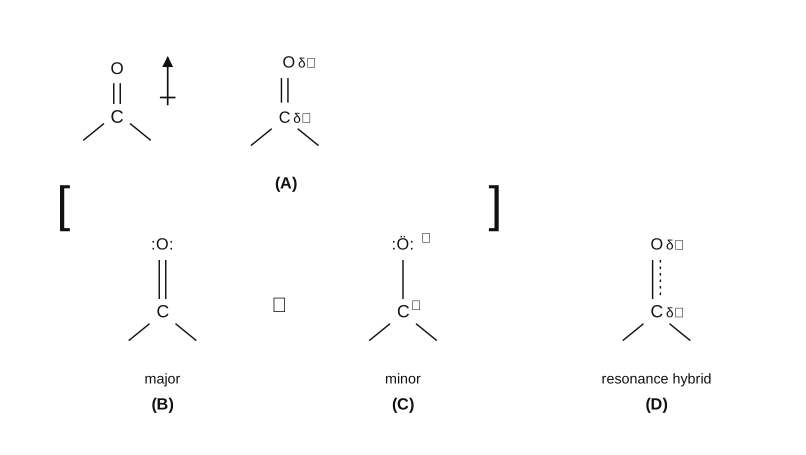
The polarity of the carbonyl group originates from two combined effects: oxygen's higher electronegativity relative to carbon (a purely inductive effect), AND resonance effects specific to the C=O pi system (Fig. 12.4). In the neutral, MAJOR resonance contributor (labelled A), the carbonyl is a plain, full C=O double bond. Alongside it, a MINOR charge-separated resonance contributor (labelled B/C) can be drawn, in which the pi electrons have shifted fully onto oxygen -- giving a single C-O bond, a formal negative charge on oxygen, and a formal positive charge on the carbon. The real carbonyl group is best described as a RESONANCE HYBRID (D) of these two contributing structures: not fully double-bonded like A, nor fully charge-separated like B, but somewhere genuinely in between -- with the carbonyl carbon carrying a partial positive charge (delta-plus) and the oxygen a partial negative charge (delta-minus). Because this leaves the carbonyl CARBON measurably electron-deficient, it behaves as an ELECTROPHILE (an electron-loving centre), and is consequently susceptible to attack by any …
Drawn by us to help you understand the concept clearly, and verified to make sure it's accurate. For exams, practice from your textbook's own diagram.
What this figure shows. Three/four related drawings of a generic carbonyl group C=O. (A), the major resonance contributor: a plain neutral C=O double bond. (B) and (C): minor charge-separated resonance contributors showing a single C-O bond with a formal positive charge on carbon and a formal negative charge on oxygen (drawn with a curved-arrow-style electron shift from the pi bond onto oxygen). (D), the resonance hybrid: the same C=O drawn with a delta-plus on carbon and a delta-minus on oxygen, representing the real, partially-charge-separated, averaged structure. A second labelled panel underneath contrasts a ketone's carbonyl carbon (bonded to two R groups) against an aldehyde's (bonded to one R and one H), both marked delta-plus/del …