Chemistry · Ch 13 — Amines
Gabriel phthalimide synthesis
Gabriel phthalimide synthesis
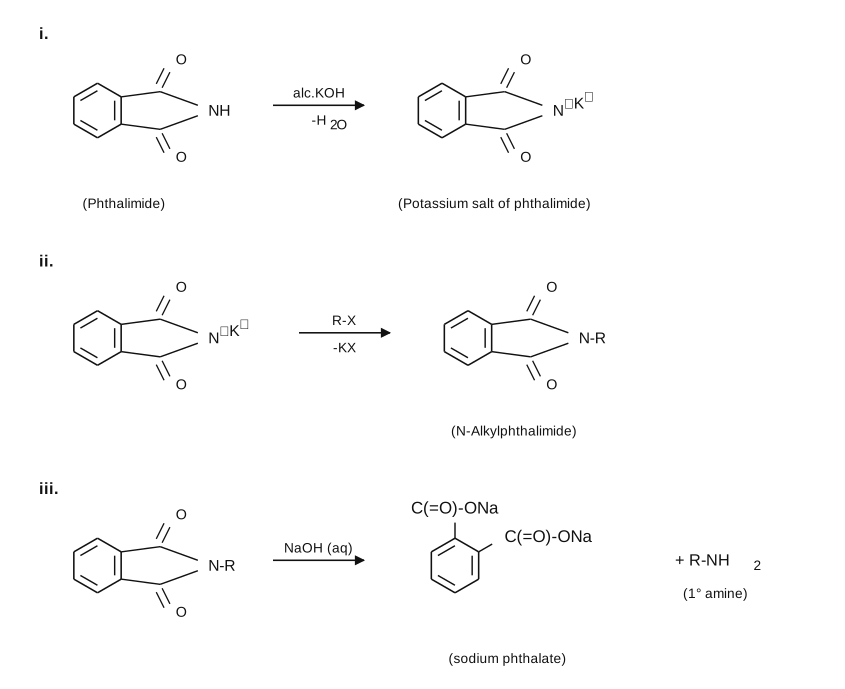
The Gabriel phthalimide synthesis is a method specifically for making PRIMARY amines, and it proceeds through three distinct stages, each converting one intermediate into the next. Stage (i): phthalimide (a cyclic compound with an N-H nitrogen flanked by two ring-fused carbonyl groups, derived from phthalic acid) reacts with alcoholic potassium hydroxide, losing a molecule of water, to form the potassium salt of phthalimide -- the acidic N-H proton is removed by the base, leaving a negatively-charged nitrogen balanced by the potassium counter-ion. Stage (ii): this potassium salt of phthalimide, acting as a nucleophile, reacts with an alkyl halide (R-X) in a substitution reaction that displaces the halide ion (as KX), giving N-alkylphthalimide -- the same ring system, now bearing an alkyl group on its nitrogen in place of the potassium. Stage (iii): N-alkylphthalimide is subjected to alkaline hydrolysis, which breaks both of the nitrogen's carbon-nitrogen bonds to the ring, releasing the free primary amine, R-NH2, and leaving behind the sodium salt of phthalic acid (sodium phthalate) as the other product. A crucial limitation of this whole method is stated explicitly: aromatic amines CANNOT be prepared this way, because stage (ii) requires the alkyl halide to undergo nucleophilic substitution with the phthalimide anion, and aryl halides simply do not underg …
Drawn by us to help you understand the concept clearly, and verified to make sure it's accurate. For exams, practice from your textbook's own diagram.
Worked out. Stage (i): phthalimide (the cyclic imide of phthalic acid, with an N-H between its two ring-fused -C(=O)- groups) reacts with alcoholic KOH, losing water, to give the potassium salt of phthalimide (the N-H proton removed, N now bearing a negative charge balanced by K+). Stage (ii): this potassium salt reacts with an alkyl halide R-X (losing KX, an SN2 displacement at the alkyl halide's carbon) to give N-alkylphthalimide, the same cyclic two-carbonyl ring now bearing an N-R group in place of the N-H. Stage (iii): N-alkylphthalimide is hydrolysed with aqueous NaOH to break both C-N bonds of the ring, releasing the primary amine R-NH2 and leaving behind the disodium salt of phthalic acid (sodium phthalate, the ring's two carbons now each bearing a -C(=O)-O(-)Na(+) group). Because aryl halides do not undergo the nucleophilic substitution needed in stage (ii) with the phthalimide …