Chemistry · Ch 13 — Amines
Intermolecular forces, boiling points and solubility
Intermolecular forces, boiling points and solubility
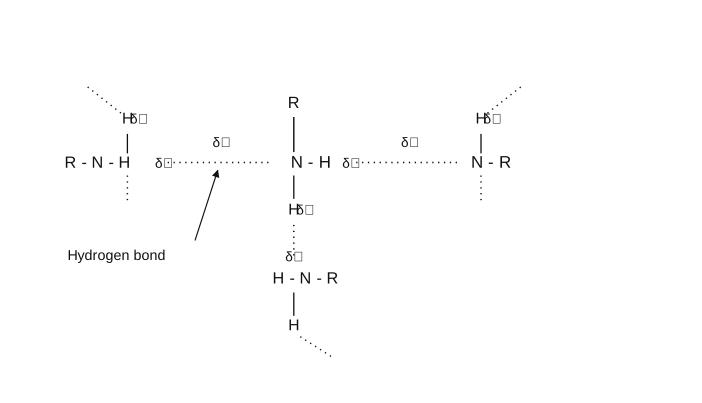
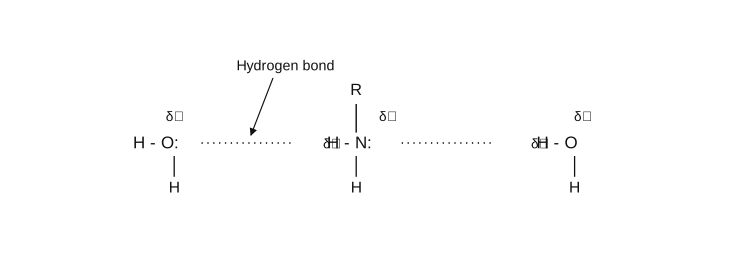
The N-H bond found in primary and secondary amines is a polar bond, because nitrogen (electronegativity 3.0) and hydrogen (electronegativity 2.1) differ noticeably in their pull on the shared bonding electrons. Because of this polarity, primary and secondary amines can hydrogen-bond to one another between separate molecules (intermolecular hydrogen bonding); this hydrogen bonding is present to a GREATER extent in primary amines than in secondary amines, simply because a primary amine has TWO hydrogen atoms bonded to its nitrogen (both available to take part in hydrogen bonding, see Fig. 13.1) whereas a secondary amine has only ONE. Tertiary amines, having NO hydrogen atom at all bonded to their nitrogen, cannot hydrogen-bond intermolecularly in this way at all -- but because the carbon-nitrogen bonds in a tertiary amine are still themselves polar, tertiary-amine molecules are still polar overall and do experience weaker intermolecular dipole-dipole attractive forces between one another. Taken together, the overall strength of intermolecular attractive forces runs strongest in primary amines and weakest in tertiary amines, and this directly explains the OBSERVED order of boiling points among isomeric amines: primary amine > secondary amine > tertiary amine (see Table 13.3, rows 1-3, for three isomeric 73-molar-mass amines illustrating exactly this order). Amines as a physical class span a range of states at ordinary temperature and pressure: the LOWER aliphatic amines are gases with a characteristically fishy odour, MIDDLE members of the homologous series are liquids, and HIGHER members are solids. Aniline and other arylamines are usually colourless liquids as freshly prepared, but they readily pick up colour on standing, because they are easily oxidised on exposure to air. Because amines can hydrogen-bond to water molecules (through both their N-H hydrogens and their nitrogen lone pair, see Fig. 13.2), the LOWER aliphatic amines are soluble in water; this solubility steadily DECREASES as the molar mass of the amine increases, because the size of the non-polar, hydrophobic alkyl portion of the molecule grows relative to the small polar -NH2/NH/N head group -- so aromatic amines and higher aliphatic amines end up practically insoluble in water. Because the N-H bond in amines is LESS polar than the O-H bond in al …
Drawn by us to help you understand the concept clearly, and verified to make sure it's accurate. For exams, practice from your textbook's own diagram.
What this figure shows. Several primary-amine molecules (R-NH2) drawn hydrogen-bonded to one another in a chain: each molecule's N-H hydrogen (marked delta-plus) is drawn pointing toward the lone-pair-bearing nitrogen (marked delta-minus) of a neighbouring molecule, with the hydrogen bond itself drawn as a dashed line labelled 'Hydrogen bond'. Because a primary amine has TWO hydrogens on nitrogen available for this kind of bonding (versus only one in a secondary amine, and none in a tertiary amine), primary amines show the most extensive intermolecular hydrogen-bonding network of the three classes, which the running text uses to explain why primary ami …
Drawn by us to help you understand the concept clearly, and verified to make sure it's accurate. For exams, practice from your textbook's own diagram.
What this figure shows. An amine molecule (R-NH2, its nitrogen's lone pair and N-H hydrogens marked delta-minus/delta-plus) drawn hydrogen-bonded to a surrounding water molecule (H-O-H, its own oxygen lone pair and hydrogens similarly marked delta-minus/delta-plus), with the hydrogen bond itself drawn as a dashed line. This is the interaction responsible for the water-solubility of lower aliphatic amines -- both the amine's N-H (as donor) and its N lone pair (as acceptor) can hydrogen-bond to water, though because N-H is less polar than O-H, this bonding is weaker than that between two alcohol (or acid) molecules, so amines are less water-soluble than …
Table 13.3 lists seven ~72-74 molar-mass compounds with their boiling point in Kelvin, illustrating both the primary>secondary>tertiary amine trend (rows 1-3) and the alkanes<amines<alcohols<carboxylic-acid trend (rows 4-7). 1. n-C4H9NH2 (n-butylamine, a primary amine), molar mass 73, b.p. 350.8 K. 2. (C2H5)2NH (diethylamine, a secondary amine), molar mass 73, b.p. 329.3 K. 3. C2H5N(CH3)2 (ethyldimethylamine, a tertiary amine), molar mass 73, b.p. 310.5 K. 4. C2H5COOH (propionic acid), molar mass 74, b.p. 414.4 K. 5. n-C4H9OH (n-butanol), molar mass 74, b.p. 390.3 K. 6. (CH3)3C-NH2 (tert-butylamine, a primary amine, isomeric wit …