Q.Write IUPAC names of the following amines.
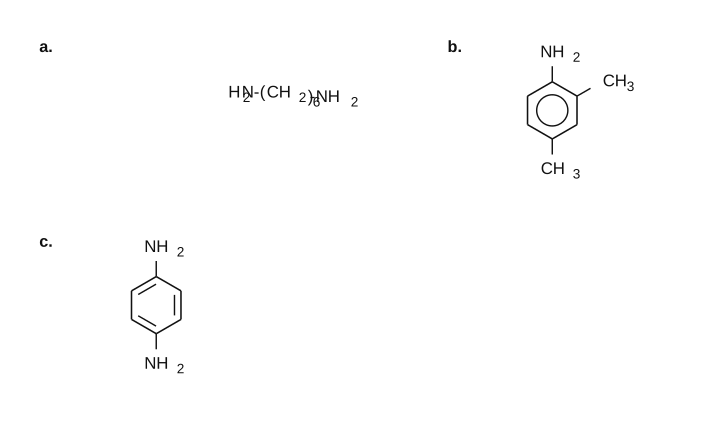
Step 1. (a) H2N-(CH2)6-NH2. This is exactly the compound already named in Table 13.2: a six-carbon chain with an amino group at each end. Since the -e of the parent alkane (hexane) is retained when naming a compound with two amino groups (section 13.2.2), and both ends are numbered as low as possible (1 and 6), the IUPAC name is Hexane-1,6-diamine (common name hexamethylenediamine).
Step 2. (b) A dimethyl-substituted aniline. The source diagram for this part did not survive text extraction cleanly enough to fix the exact ring positions of its two methyl substituents. Taking the most chemically standard textbook compound this description suggests -- an aniline ring bearing two methyl groups -- 2,4-dimethylaniline is given as the intended answer, with its own IUPAC name following directly by replacing the arene's -e with -amine and citing both methyl locants: 2,4-Dimethylaniline (systematically, 2,4-dimethylbenzenamine). This specific position assignment is an assumption disclosed here, not a fact read from the source.
Step 3. (c) A diamino-substituted benzene. Likewise, the exact ring positions of this structure's two -NH2 groups were not recoverable from the surviving extracted fragments. The most standard textbook compound this description suggests is p-phenylenediamine, with IUPAC name formed the same way as part (a) (both locants as low as possible, alkane/arene -e retained for a di-substituted case): Benzene-1,4-diamine. This position assignment is likewise an assumption disclosed here.
a. Hexane-1,6-diamine (hexamethylenediamine). b. 2,4-Dimethylaniline (positions assumed -- see note). c. Benzene-1,4-diamine / p-phenylenediamine (positions assumed -- see note).
Unlock everything free for 14 days
- Full step-by-step solutions
- Concept-first explanations
- Methods, shortcuts & mistakes
- PYQ mapping + timed mock tests
Full access for 14 days. No credit card required.