Chemistry · Ch 13 — Amines
Reactions involving retention of diazo group (Coupling reactions)
Reactions involving retention of diazo group (Coupling reactions)
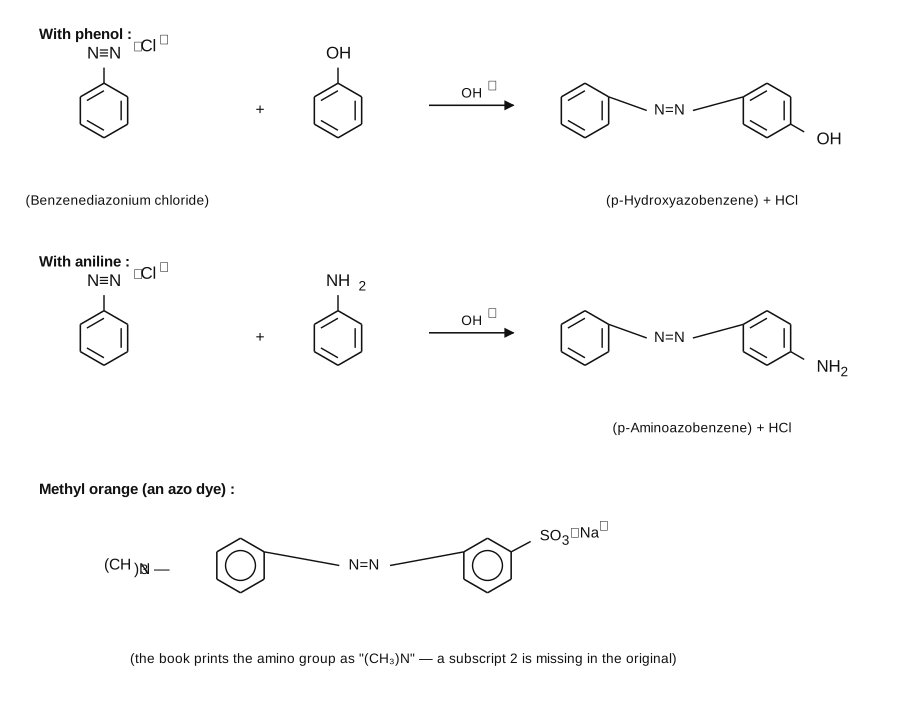
In direct contrast to section 13.7.1's substitution reactions, arene diazonium salts can also react with certain OTHER, particularly reactive aromatic compounds -- specifically phenols or aromatic amines -- in a way that RETAINS the diazonium group fully intact, giving AZO compounds as the product; this whole class of reaction is called azo coupling. The azo compounds formed this way carry an extended, conjugated system of alternating double bonds, in which the two separate aromatic rings involved (one from the original diazonium salt, one from the phenol or amine coupling partner) are now joined together through a shared -N=N- azo linkage; because of this extended conjugation, azo compounds are typically brightly coloured, and this is exactly the property that makes them so useful and widely used as synthetic dyes. Mechanistically, azo coupling is properly understood as one particular example of an electrophilic aromatic substitution reaction: here, the positively-charged diazonium ion itself is the attacking electrophile, and it substitutes onto the second aromatic ring (the phenol or amine) usually at the position PARA to that second ring's own strongly ring-activating group (its -OH or -NH2). Worked with two specific examples: benzenediazonium chloride reacts with phenol, in mild alkaline reaction medium, to give p-hydroxyazobenzene, an orange-coloured dye, as product. Benzenediazonium chloride reacts, under the very same mild alkaline conditions, with aniline instead to give p-aminoazobenzene, a yellow-coloured dye. This same azo-coupling reaction, specifically using beta-naphthol dissolved in NaOH as the coupling partner, is exact …
Drawn by us to help you understand the concept clearly, and verified to make sure it's accurate. For exams, practice from your textbook's own diagram.
Worked out. Benzenediazonium chloride reacts with phenol in mild alkaline medium to give p-hydroxyazobenzene, an orange dye, with the electrophilic diazonium ion substituting para to phenol's activating -OH group. Benzenediazonium chloride reacts similarly with aniline in mild alkaline medium to give p-aminoazobenzene, a yellow dye, substituting para to aniline's activating -NH2 group. A 'Do you know?' aside notes that the common acid-base indicator methyl orange is itself an azo dye, its structure carrying the characteristic -N=N- azo linkage between two aromatic rings, one of them bearing a -SO3Na group an …