Chemistry · Ch 14 — Biomolecules
Enzymes
Enzymes
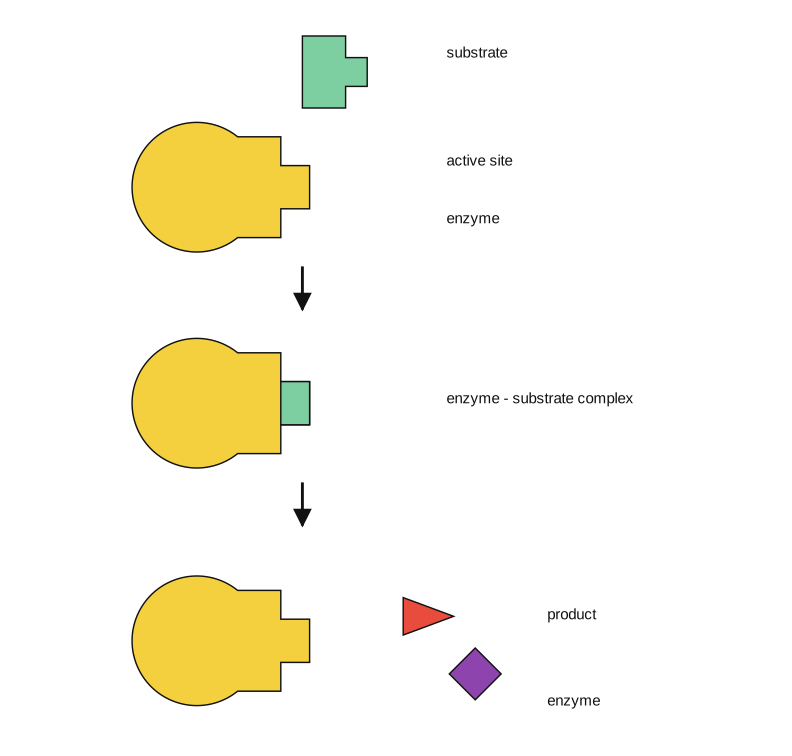
Enzymes are the biological catalysts responsible for the enormous number of chemical reactions that must occur inside a living body, all proceeding efficiently under the comparatively mild, constant conditions of physiological pH (about 7.4) and normal body temperature (about 37 C). Chemically, every enzyme is itself a protein. A single living cell contains at least a thousand different enzymes, and -- unlike a general chemical catalyst such as a mineral acid, which might catalyse the hydrolysis of many structurally different classes of compound (esters, acetals, amides) more or less indiscriminately -- most individual enzymes catalyse only ONE specific reaction, or at most one small group of closely related reactions; an enzyme specific for hydrolysing amide bonds, for instance, will typically show essentially no catalytic activity toward an ester or an acetal. This remarkable specificity is explained by the 'lock-and-key' mechanism of enzyme action: an enzyme presents an active site on its surface, a pocket or cleft with a very particular size and shape; a substrate molecule can bind productively at this active site ONLY if its own size and shape are complementary to it (much as only the correctly-shaped key fits a given lock). Once bound, forming a transient enzyme-substrate complex, the substrate is held by the active site in precisely the correct orientation to undergo its reaction, converting it into product; the product (no longer a good fit for the active site, having changed shape/structure) then leaves, freeing the enzyme molecule to bind and process another substrate molecule, over and over. Because assembling the enzyme-substrate complex requires only a very LOW activation energy compared with the uncatalysed reaction, the enzyme-catalysed reaction proceeds at a dramatically higher rate than it otherwise would -- some enzymes are efficient enough to process as many as 10,000 individual substrate molecules per single enzyme molecule, every second. Enzymes are today widely isolated directly from organisms such as bacteria (purified and crystallised, with the amino-acid sequences of many now fully determined), and are also increasingly manufactured artificially using genetic engineering. Industrially, enzyme catalysis is put to practical use in several well-known processes: glucose isomerase converts glucose into the sweet …
Drawn by us to help you understand the concept clearly, and verified to make sure it's accurate. For exams, practice from your textbook's own diagram.
What this figure shows. A four-panel schematic: (1) a free enzyme molecule, drawn with a distinctively-shaped notch/pocket on its surface labelled the 'active site', and a separate, differently-shaped small molecule labelled the 'substrate' approaching it; (2) the substrate fitting precisely into the active site, forming the 'enzyme-substrate complex' -- only a substrate of the right size and shape can dock here, exactly as a key fits only its matching lock; (3) the bound substrate reacting (held in the correct orientation by the active site) and converting into 'product' while still enzyme-bound; (4) the product being released and the enzyme returning to its original free state, ready to bind another substrate molecule and repeat the cycle -- illustrating why one enzyme molecule can process thou …