Chemistry · Ch 5 — Electrochemistry
Dry cell (Leclanche' cell)
Dry cell (Leclanche' cell)
The dry cell is a cell without a liquid component — but the electrolyte is not completely dry: it is a viscous aqueous paste.
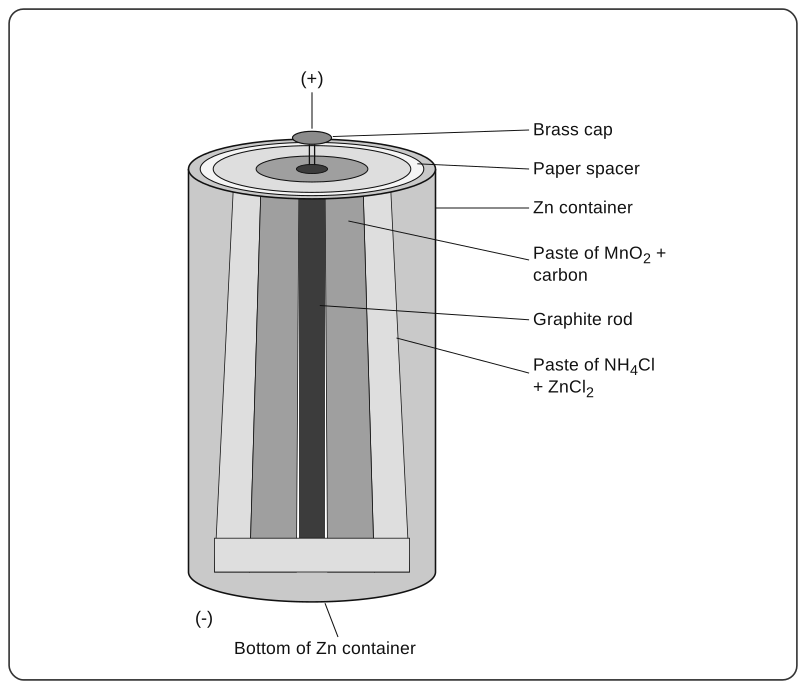
Construction : The container of the cell is made of zinc, which serves as the anode (-). It is lined from inside with a porous paper to separate it from the other material of the cell. An inert graphite rod in the centre of the cell, immersed in the electrolyte paste, serves as the cathode (+). It is surrounded by a paste of manganese dioxide () and carbon black. The rest of the cell is filled with the electrolyte — a moist paste of ammonium chloride () and zinc chloride (). Some starch is added to the paste to make it thick, so that it cannot be leaked out. The cell is sealed at the top to prevent drying of the paste by evaporation of moisture. See Fig. 5.8.
Drawn by us to help you understand the concept clearly, and verified to make sure it's accurate. For exams, practice from your textbook's own diagram.
What this figure shows. The nested construction of the dry cell, from the centre outward: the graphite rod cathode topped by the brass cap (+); the paste of MnO₂ + carbon packed around the rod; the paste of NH₄Cl + ZnCl₂ electrolyte filling the rest; the paper spacer lining; and the **Zn contain …
Cell reactions:
i. Oxidation at anode : When the cell operates, the current is drawn from the cell and metallic zinc is oxidised to zinc ions:
ii. Reduction at cathode : The electrons liberated in the oxidation at the anode flow along the container and migrate to the cathode. At the cathode, ions are reduced:
The hydrogen gas produced in the reduction reaction is oxidised by , which prevents its collection on the cathode:
The net reduction reaction at the cathode is the combination of these two reactions:
iii. Net cell reaction : The net cell reaction is the sum of the oxidation at the anode and the reduction at the cathode:
The ammonia produced combines with to form a soluble compound containing the complex ion:
Do you know? …