Chemistry · Ch 5 — Electrochemistry
Lead storage battery (Lead accumulator)
Lead storage battery (Lead accumulator)
The lead accumulator stores electrical energy due to the regeneration of the original reactants during recharging. It functions as a galvanic cell and as an electrolytic cell as well.
Construction : A group of lead plates packed with spongy lead serves as the anode (-). Another group of lead plates bearing lead dioxide () serves as the cathode (+). To provide a large reacting surface, the cell contains several plates of each type, the two types alternately arranged as shown in Fig. 5.9. The electrodes are immersed in an electrolytic aqueous solution of 38 % (by mass) sulphuric acid, of density 1.2 g/mL.
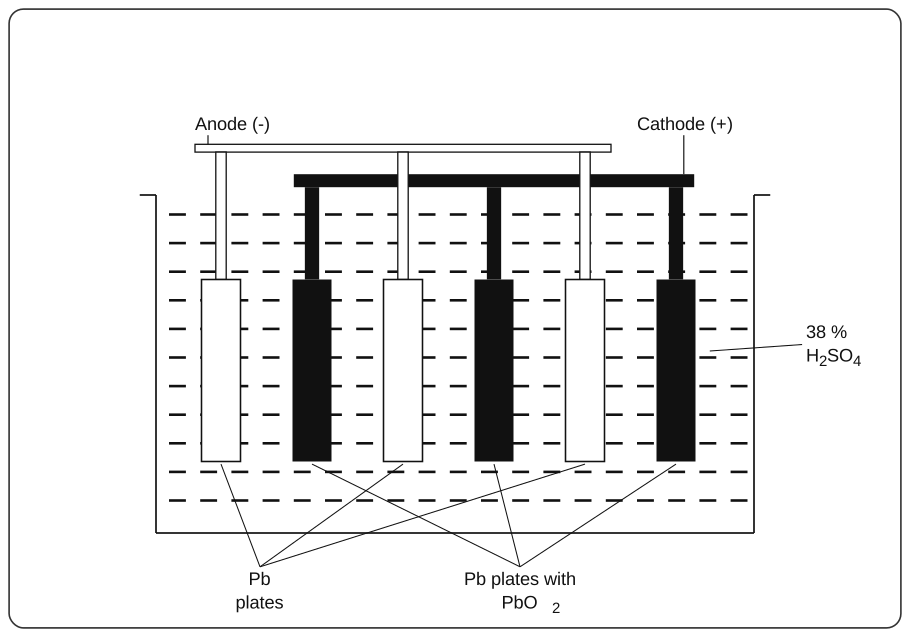
Drawn by us to help you understand the concept clearly, and verified to make sure it's accurate. For exams, practice from your textbook's own diagram.
What this figure shows. The plate stack of the lead accumulator: the Pb plates (spongy lead, Anode (-)) alternate with the Pb plates with PbO₂ (Cathode (+)), all dipped in the 38 % H₂SO₄ electrolyte (dashes mark the liquid). Alternating several plates of each type …
Notation of the cell : The cell is formulated as
a. Cell reactions during discharge
i. Oxidation at anode (-) : When the cell provides current, spongy lead is oxidised to ions and negative charge accumulates on the lead plates. The ions so formed combine with ions from to form insoluble . The net oxidation is the sum of these two processes:
ii. Reduction at cathode (+) : The electrons produced at the anode travel through the external circuit and re-enter the cell at the cathode. At the cathode, is reduced to ions in the presence of ions. Subsequently the ions so formed combine with ions from to form insoluble that gets coated on the electrode:
In the print, the middle (precipitation) line under the cathode reads "Pb (s) + SO₄²⁻ (aq) ⟶ PbSO₄ (s)" — the same line as the anode's precipitation step. Chemically it is the ions formed by the reduction that precipitate (as the book's own surrounding text and the overall equation (ii) confirm); the corrected ion form is shown above.
iii. Net cell reaction during discharge : The net cell reaction is the sum of the overall oxidation at the anode and the overall reduction at the cathode:
or, in terms of sulphuric acid,
As the cell operates to generate current, is consumed; its concentration (density) decreases and the cell potential is decreased. The cell potential thus depends on the sulphuric acid concentration (density).
b. Cell reactions during recharging : The potential of the lead accumulator is 2 V. It must be recharged when the cell potential falls to 1.8 V. To recharge the cell, an external potential slightly greater than 2 V needs to be applied across the electrodes. During recharging the cell functions as an electrolytic cell: the anode and cathode are interchanged, with the electrode being the anode (+) and the lead electrode the cathode (-). The reaction numbering continues the discharge list, as in the book:
iv. Oxidation at anode (+) : It is the reverse of the reduction reaction (ii) at the cathode that occurs during discharge:
…