Chemistry · Ch 1 — Solid State
Crystal, lattice and basis
Crystal, lattice and basis
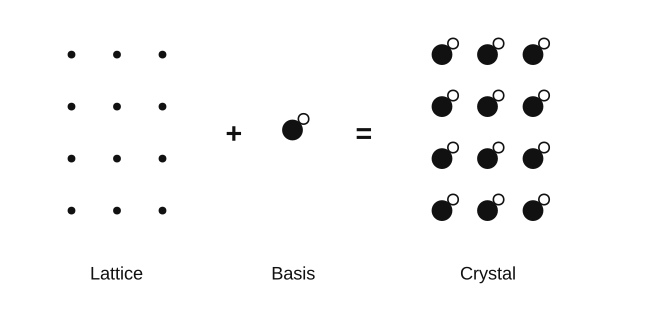
A lattice is a geometrical arrangement of points in a three-dimensional periodic array -- purely a mathematical scaffold of positions, with no physical particle yet attached to it. A crystal structure is obtained by attaching a constituent particle (an atom, an ion or a molecule) to each and every one of these lattice points; the constituent particles attached in this way are together called the basis of the crystal lattice. The relationship is summarised as:
Drawn by us to help you understand the concept clearly, and verified to make sure it's accurate. For exams, practice from your textbook's own diagram.
What this figure shows. A pictorial equation in three parts. Left: a regular grid of small dots -- the bare lattice points. Centre: a single basis motif (one large filled circle with a small open circle attached). Right: the crystal -- the same grid, but with a copy of the two-circle basis motif sitting on every lattice point …
…