Chemistry · Ch 1 — Solid State
Unit Cell
Unit Cell
The space lattice of a crystal is built up by repeating a three-dimensional basic pattern; this smallest repeating structural unit of a crystalline solid is called the unit cell. When unit cells are stacked together to build up the full crystal, each unit cell shares its faces, edges and corners with the neighbouring unit cells around it. An important geometric fact is that the shape of a unit cell is the same as the shape of the macroscopic crystal it builds -- a crystal with an overall cubic shape is built from unit cells that are themselves tiny cubes. A unit cell is completely described by six parameters: the lengths of its three edges along the three axes, denoted , and , …
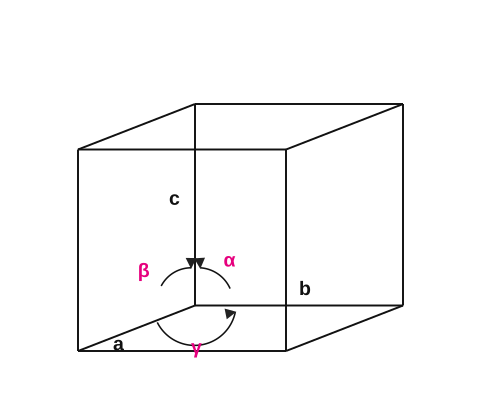
Drawn by us to help you understand the concept clearly, and verified to make sure it's accurate. For exams, practice from your textbook's own diagram.
What this figure shows. A wireframe parallelepiped (cube-like box) in 3-D perspective. Three edges meeting near one vertex carry the labels , and , and the three interaxial angles are marked with small curved arcs and Greek letters: between edges and , between and , and between and -- the six parameters that co …