Chemistry · Ch 1 — Solid State
Crystal systems
Crystal systems
Mathematical analysis shows that only fourteen distinct kinds of three-dimensional space lattice are geometrically possible -- there are just 14 ways in which identical points can be arranged in a periodic three-dimensional order. These fourteen lattices are called the Bravais lattices. They fall into seven crystal systems, which arise from the possible combinations of the three edge-length parameters (, , ) and the three interaxial angles (, , ): cubic, orthorhombic, tetragonal, monoclinic, rhombohedral, triclinic and hexagonal. The cubic system, being the simplest and the most symmetric, is the one studied in greatest depth in this chapter.
Do you know?
The names of the fourteen Bravais lattices (unit cells) for each of the seven crystal systems are shown below.
| Crystal system | Bravais lattices |
|---|---|
| 1. Cubic | i. simple or primitive · ii. body-centred · iii. face-centred |
| 2. Orthorhombic | i. simple or primitive · ii. body-centred · iii. face-centred · iv. base-centred |
| 3. Tetragonal | i. simple or primitive · ii. body-centred |
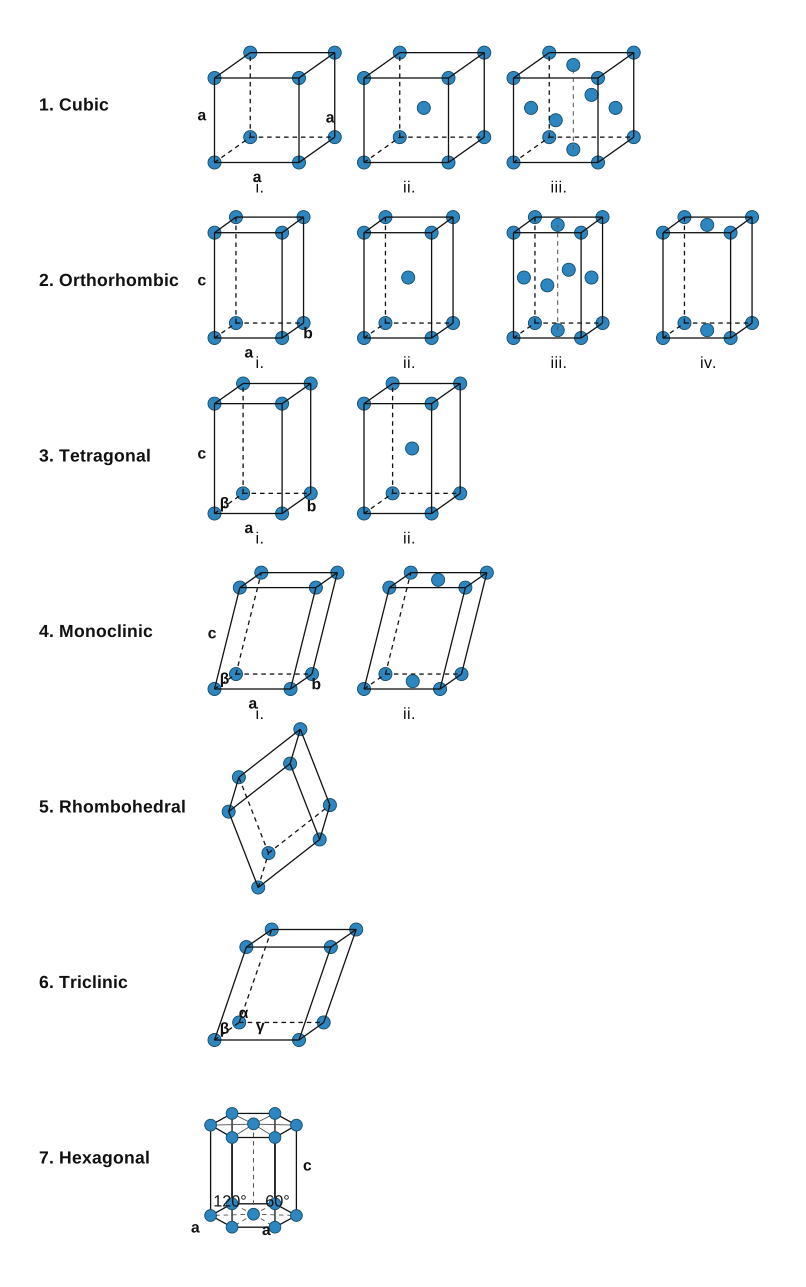
Drawn by us to help you understand the concept clearly, and verified to make sure it's accurate. For exams, practice from your textbook's own diagram.
What this figure shows. Fourteen small wireframe unit-cell drawings with balls at the lattice points and dashed hidden edges, arranged row by row per crystal system. Cubic: primitive (edges marked , , ), body-centred and face-centred. Orthorhombic: primitive (edges , , ), body-centred, face-centred and base-centred. Tetragonal: primitive (with edge labels and the angle marked) and body-centred. Monoclinic: primitive (a skewed prism with edges , , and angle ) and base-centred. Rhombohedral: one rhombohedron. Triclinic: one skewed parallelepiped with angles , , marked. Hexagonal: one hexagonal prism with balls at …