Chemistry · Ch 2 — Solutions
Factors Affecting Solubility
Factors Affecting Solubility
The extent to which a substance dissolves in a solvent varies greatly with different substances. It depends on the nature of solute and solvent, temperature and pressure.
i. Nature of solute and solvent : Generally the compounds with similar chemical character are more readily soluble in each other than those with entirely different chemical characters. The saying that 'like dissolves like' guides us in predicting the solubility of a solute in a given solvent. Thus, substances having similar intermolecular forces are likely to be soluble in each other. Generally polar solutes dissolve in polar solvents: in these, the solute-solute, solute-solvent and solvent-solvent interactions are all of similar magnitude. For example, NaCl dissolves in water -- the strong ion-dipole interactions of and ions with water molecules, the hydrogen bonding between water molecules, and the ion-ion attractions between and ions are all comparable. (The textbook prints these ionic charges in its circled style, as Na and Cl.) Nonpolar organic compounds like cholesterol dissolve in nonpolar solvents such as benzene. Sugar dissolves in water! The dissolution of sugar in water is due to intermolecular hydrogen bonding between sugar and water.
ii. Effect of temperature on solubility : How the solubility of a substance changes with temperature depends on the enthalpy of solution. Many solids, for example KCl, dissolve in water by an endothermic process, that is, with the absorption of heat. When temperature is increased by adding heat to the system, the solubility of the substance increases according to the Le-Chatelier principle: the addition of heat causes a stress on the saturated solution, and this stress favours the endothermic process. On the other hand, when a substance dissolves in water by an exothermic process, its solubility decreases with an increase of temperature. Substances such as and dissolve in water releasing heat.
It is important to understand that there is no direct correlation between solubility and exothermicity or endothermicity. For example, the dissolution of in water is exothermic and that of is endothermic -- yet the solubility of these increases with the temperature.
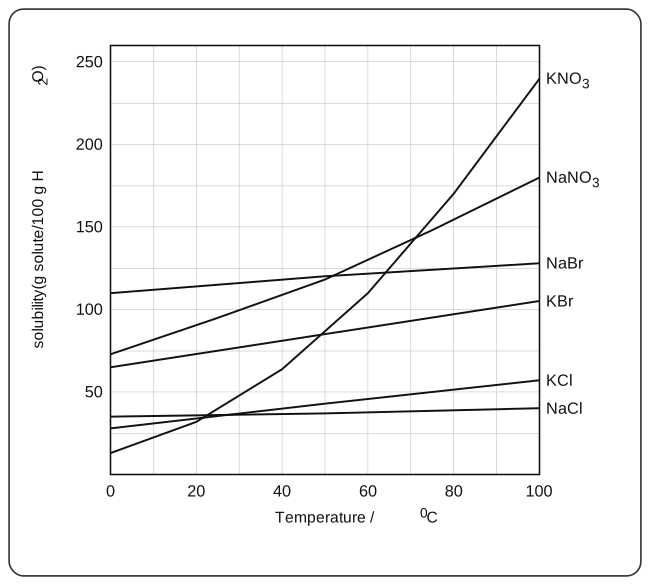
Figure 2.1 shows the result of experimental determination of solubilities of some ionic solids in water at various temperatures. Following are some experimental observations from Fig. 2.1:
i. Solubilities of NaBr, NaCl and KCl change slightly with temperature.
ii. Solubilities of , and KBr increase appreciably with increasing temperature.
iii. Solubility of decreases with increase of temperature.
Drawn by us to help you understand the concept clearly, and verified to make sure it's accurate. For exams, practice from your textbook's own diagram.
What this figure shows. Solubility (in g solute per 100 g , y-axis, gridded 50-250) plotted against temperature (0-100 C, x-axis) for six ionic solids, each drawn as its own labelled curve. rises most steeply, rises strongly, NaBr and KBr rise moderately, while KCl rises only slightly and NaCl stays almost flat -- experimental proof that the …
The solubility of gases in water usually decreases with an increase of temperature. When gases are dissolved in water, the gas molecules in the liquid phase are condensed. Condensation is an exothermic process, so the solubility of gases in water must decrease as temperature is raised.
In the United States about billion gallons of water from rivers and lakes are used for industrial cooling. The cooling process heats the water, and the hot water then returns to the rivers and lakes. The solubility of oxygen decreases in hot water, thereby affecting the life of cold-blooded animals like fish.
iii. Effect of pressure on solubility : Pressure has no effect on the solubilities of solids and liquids, as they are incompressible. However, pressure greatly affects the solubility of gases in liquids: the solubility of a gas increases with increasing pressure. The quantitative relationship between gas solubility in a liquid and pressure is given by Henry's law.
Henry's law : It states that the solubility of a gas in a liquid is directly proportional to the pressure of the gas over the solution. Thus,
where is the solubility of the gas in , is the pressure of the gas in bar over the solution, and , the proportionality constant, is called Henry's law constant.
Units of :
When bar, . Thus, is the solubility of the gas in a liquid when its pressure over the solution is 1 bar.
Demonstration of Henry's law. …