Theorem 6.7 (Distance between parallel lines). The distance between parallel lines r=a1+λb and r=a2+λb (note that both lines share the same direction vector b, which is exactly what makes them parallel) is (a2−a1)×b^, where b^=b/∣b∣ is the unit vector along b.
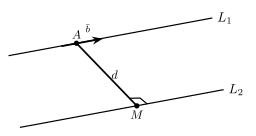
Proof (outline). Let L1 pass through A(a1) and L2 pass through B(a2), both lines running in the direction b (Fig. 6.7). Drop a perpendicular BM from B onto L1, meeting L1 at the foot M; this perpendicular length BM is exactly the distance we want. In the right-angled triangle AMB, let θ=∠BAM be the angle that AB makes with the common direction b at A. Then sinθ=ABBM, so BM=ABsinθ=AB⋅∣b^∣sinθ. But AB⋅∣b^∣sinθ is precisely the magnitude of the cross product AB×b^=(a2−a1)×b^. Hence the distance between the two parallel lines is d=BM=(a2−a1)×b^.
Ex.(17) Find the distance between parallel lines r=(2i^−j^+k^)+λ(2i^+j^−2k^) and r=(i^−j^+2k^)+μ(2i^+j^−2k^)
Solution. Here a1=2i^−j^+k^, a2=i^−j^+2k^, b=2i^+j^−2k^.
Alternative method (distance of a point from a line). The distance between r=a1+λb and r=a2+λb equals the distance of the point A(a1) from the line r=a2+λb, given by
d=∣a1−a2∣2−[∣b∣(a1−a2)⋅b]2
Here a1−a2=i^−k^, so ∣a1−a2∣=2; and (a1−a2)⋅b=(i^−k^)⋅(2i^+j^−2k^)=2+0+2=4, with ∣b∣=3. So
d=2−(34)2=2−916=92=32 unit,
matching the first method exactly.
Ex.(18) Find the distance between parallel lines 2x=−1y=2z and 2x−1=−1y−1=2z−1 …
Figure 6.7Fig. 6.7 — Distance between two parallel lines L₁ and L₂ = the perpendicular distance d between them
ⓘDrawn by us to help you understand the concept clearly, and verified to make sure it's accurate. For exams, practice from your textbook's own diagram.
What this figure shows. Fig. 6.7 accompanies the proof of Theorem 6.7 for the distance between two parallel lines L1 and L2, both running in the common direction b-bar. Line L1 passes through A(a-bar 1) and line L2 passes through B(a-bar 2). The segment BM is drawn perpendicular to L1, meeting it at the foot M (marked with a right angle), while theta = angle BAM is the angle AB makes with the common direction b-bar at A. The perpendicular segment BM, of le …