Mathematics · Ch 6 — Line and Plane
Passing through a point and parallel to a vector
Passing through a point and parallel to a vector
Theorem 6.1 (vector form, point + direction vector). Suppose a line passes through a fixed point whose position vector is , and is parallel to a given vector . Let be any other point on , with position vector . Since lies on and is parallel to , the vector must itself be parallel to , so it can be written as a scalar multiple of : for some real number . But by the triangle law of vector addition, . Combining the two gives , i.e. This is the vector equation of the line. The real number is called a parameter: as runs over all real numbers, the point traces out every point of the line exactly once, so there is a one-to-one correspondence between the points of and the values of — this is why the equation is called the parametric form of the vector equation of a line. A quick activity worth doing mentally is to substitute a few different values of (say , , ) into to see three different position vectors, all lying on the same line. The same geometric fact — that is parallel to — can also be written without a parameter at all, using the property that two parallel (non-zero) vectors have zero cross product: . This is called the non-parametric form of the vector equation, and it is completely equivalent to the parametric form; it simply says directly that the vector from to any point of the line is always parallel to , without introducing explicitly.
Theorem 6.2 (Cartesian form, point + direction ratios). The same line can be described using coordinates instead of vectors. Suppose passes through and has direction ratios (meaning a vector parallel to has components proportional to ). Let be any other point on . The direction ratios of the segment are then . Since lies along , these direction ratios must be proportional to the line's own direction ratios — that is exactly what it means for two sets of direction ratios to represent the same direction. Writing this proportionality as a chain of equal ratios gives which are the Cartesian equations of the line. Unlike a line in a plane, a line in space genuinely needs two independent equations (this chain of ratios is really two equations joined together) — a single equation in describes a plane, not a line, so it is impossible to pin down a line in space with just one Cartesian equation.
A few standing conventions are worth stating explicitly, since they recur throughout the chapter. If is a vector parallel to a line, then are direction ratios of that line, and conversely any set of direction ratios gives a parallel vector — the vector and Cartesian descriptions are simply two faces of the same underlying direction. When the equal ratios above are all set equal to the parameter itself, i.e. , the result is called the symmetric form of the Cartesian equations. Separating out of each ratio instead gives , called the parametric form of the Cartesian equations; the coordinates of the general point on the line are therefore , and exactly as with the vector form, each real value of gives one point of the line and each point of the line corresponds to exactly one value of . The symmetric form is only valid when none of is zero, since each one appears as a denominator; if even one of the three direction ratios is zero, the equations must be written in the parametric form instead. Finally, if we use direction cosines (a unit vector along the line) in place of general direction ratios , the general point becomes , and a short computation shows why direction cosines are especially convenient: using for direction cosines. Hence , so with direction cosines the parameter itself directly measures the distance of the point from the base point (with sign showing which side of it lies on).
Worked examples.
Ex.(1). We must check whether the point with position vector lies on the line . Setting in the line's equation and matching components gives three separate equations: , , and . Solving each on its own gives every single time, so all three coordinate equations are satisfied by one common value of ; therefore the given point does lie on the line. An equally valid alternative is to use the non-parametric idea directly: writing and , a point lies on the line exactly when is a scalar multiple of . Here , which is indeed a scalar multiple of , confirming the point lies on the line.
Ex.(2). Find the vector equation of the line through the point with position vector , parallel to . This is a direct application of Theorem 6.1 with and , giving .
Ex.(3). Find the vector equation of the line through , perpendicular to both and . Here we are not handed the required direction vector directly — instead we must build one. The cross product is always perpendicular to both and , so it must be parallel to the line we want (any line perpendicular to two given, non-parallel vectors must run along their cross product). Computing the determinant: So the required line passes through and is parallel to , giving . …
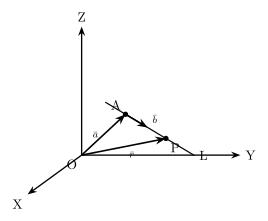
Drawn by us to help you understand the concept clearly, and verified to make sure it's accurate. For exams, practice from your textbook's own diagram.
What this figure shows. Fig. 6.1 (printed page 195) sketches the vector picture behind Theorem 6.1. It shows the three coordinate axes X, Y and Z meeting at the origin O, with a line L drawn through two of its own points, A and P. Two position vectors are drawn starting at O: vector running to the fixed point A, and vector running to the variable point P further along L. A short arrow labelled is drawn near A, parallel to the line L, showing that L runs in exactly the same direction as vector . The picture makes it visible why $\overline{AP} = \bar{r} - \bar{a} …