Physics · Ch 9 — Current Electricity
Galvanometer
Galvanometer
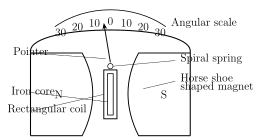
A galvanometer is a device built to detect weak electric currents flowing in a circuit. Inside it, a coil of fine wire is pivoted (or, in a more sensitive design, suspended) so that it can rotate freely, positioned between the concave pole faces of a strong, laminated horseshoe-shaped permanent magnet. When an electric current is passed through the coil, the magnetic field exerts a torque on it and it deflects; the amount of that deflection is proportional to the current passing through the coil. A pointer, fixed to the same rotating assembly as the coil, sweeps across a graduated scale as the coil turns, so the pointer's position directly indicates the size of the current through the galvanometer -- or, equivalently, the potential difference across it (since, for a fixed coil resistance, current and potential difference are directly proportional by Ohm's law). …
Drawn by us to help you understand the concept clearly, and verified to make sure it's accurate. For exams, practice from your textbook's own diagram.
What this figure shows. The internal construction of a moving-coil galvanometer: a rectangular coil of fine wire, wound on a light frame, is pivoted (or suspended by a fine suspension) so that it can rotate freely about a vertical axis, positioned in the narrow gap between the two CONCAVE pole faces of a strong, laminated horseshoe-shaped permanent magnet -- the concave shaping of the pole faces keeps the magnetic field radial at every point around the coil, so the deflection stays proportional to the current over the coil's working range. A pointer/needle is fixed to the same rotating spindle as the coil, sweeping over a graduated scale as the coil deflects; the whole assembly is characterised by two numbers used throughout this section, a moderate coil resistance G (typically around 100 …