Physics · Ch 9 — Current Electricity
Kirchhoff's Laws of Electrical Network
Kirchhoff's Laws of Electrical Network
Before the two laws themselves can be stated precisely, three words that describe the LAYOUT of a circuit need fixed meanings, because Kirchhoff's laws are written in terms of exactly these three things.
A junction (also called a node) is any point in a circuit where two or more conductors meet. It is the place where current arriving along one wire can split into several wires, or where current arriving along several wires can combine into one.
A loop, or mesh, is any closed conducting path within the network -- start at some point, follow a chain of conductors, and return to the same starting point without retracing any wire.
A branch is any single part of the network that runs between exactly two junctions, without passing through any other junction along the way. A branch may contain just one resistor, several resistors, a cell, or any combination of circuit elements, but electrically it behaves as one path carrying one well-defined current.
A simple network with only two junctions, joined by three separate branches (three distinct paths connecting the same two points), already illustrates all three ideas together: the two junctions are the only points where current can split or combine; each of the three paths between them is one branch, carrying its own branch current; and any two of the three branches, taken together, form one closed loop. …
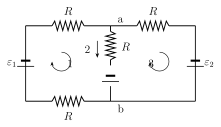
Drawn by us to help you understand the concept clearly, and verified to make sure it's accurate. For exams, practice from your textbook's own diagram.
What this figure shows. A schematic circuit diagram showing an electrical network with exactly two labelled junctions, marked a and b. Between these two junctions, three separate conducting paths (branches) run side by side, each drawn as its own wire carrying some combination of resistors and/or a cell, labelled path 1, path 2 and path 3. The figure's sole purpose is to make the definitions of junction, loop and branch concrete: point a and point b are the two junctions (each has more than two conductors meeting there, namely the three branches), each of the three individual paths 1, 2 and 3 from a to b is one branch, and any closed path formed by picking two of the three branc …