Physics · Ch 9 — Current Electricity
Kirchhoff's First Law (Current Law / Junction Law)
Kirchhoff's First Law (Current Law / Junction Law)
Kirchhoff's first law -- also called the current law or the junction law -- states that the algebraic sum of the currents meeting at any junction of an electrical network is zero:
where is the current in the -th of the conductors that meet at that junction. The word 'algebraic' is doing real work here: the currents are not just added up in magnitude, they are added with a SIGN, fixed by the following convention.
Sign convention: a current arriving AT the junction is counted positive, and a current leaving the junction is counted negative.
So if, at some junction P, six conductors meet, three carrying current INTO P (call them , , ) and three carrying current OUT of P (call them , , ), applying the sign convention gives
which can equally well be rearranged, by moving every negative term to the other side, into the more intuitive form
i.e. the total current flowing TOWARDS the junction always equals the total current flowing AWAY from it.
Physically, Kirchhoff's first law is nothing more than the conservation of electric charge, applied at a single point. Charge cannot pile up or disappear at an ordinary junction (a junction is not a capacitor plate), so whatever charge arrives per unit time at the junction from all the incoming conductors must leave, per unit time, through the outgoing conductors -- and that statement, in terms of currents (charge per unit time), is exactly the junction law. …
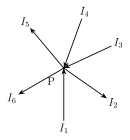
Drawn by us to help you understand the concept clearly, and verified to make sure it's accurate. For exams, practice from your textbook's own diagram.
What this figure shows. A single junction, labelled P, at which exactly six conductors meet, each carrying a labelled current: , and are drawn with their arrows pointing INTO the junction P (arriving currents), while , and are drawn with their arrows pointing AWAY from P (leaving currents). No numeric values are attached to any of the six arrows -- the figure exists purely to fix the arriving/leaving sign convention used to write , i.e. the arriving currents are counted positive a …
Worked out. A part of an electrical circuit is shown with a chain of junctions B, C and D, at each of which a main current splits into two branch currents; the figure labels every individual branch current ( through ) but the specific numeric values originally marked on the figure's arrows did not survive the text extraction, so only the book's own final worked results can be reported faithfully here. Applying Kirchhoff's first law in turn: at junction B, current splits into and , so , which the book solves to A; at junction C, , giving A; and at junction D, , giving A. The example's teaching point is purely the METHOD -- write the junction-law equation at each node in the chain, substitute the value already found at the previous node, and solve for the next unknown -- rather than the specific numbers, …