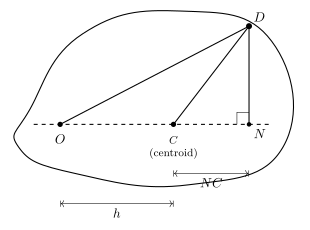
Q.In Fig. 1.15, the point D is chosen such that we have to extend OC for the perpendicular DN to fall on it. What will happen to the final expression of I₀, if point D is so chosen that the perpendicular DN falls directly on OC?
You're viewing a preview — the full solution, concept, methods & PYQ mapping are locked.
Start your 14-day free trial to unlock the full solution →Choosing D so that N lands ON segment OC only flips the sign of NC in the algebra; the cross term integrates to zero either way, so survives unchanged.
In the proof, with when N lies beyond C (OC extended). If D is instead chosen so that the foot N falls BETWEEN O and C, then , and expanding gives — the cross term now enters with a MINUS sign. But NC is precisely a signed coordinate of the mass element measured from the centre of mass along the OC direction: integrated over the whole body, by the very definition of the centre of mass, regardless of sign conventions — elements on the two sides of C cancel. So the middle term …
Unlock everything free for 14 days
- Full step-by-step solutions
- Concept-first explanations
- Methods, shortcuts & mistakes
- PYQ mapping + timed mock tests
Full access for 14 days. No credit card required.