Physics · Ch 1 — Rotational Dynamics
Theorem of Perpendicular Axes
Theorem of Perpendicular Axes
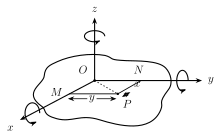
The theorem of perpendicular axes is more restrictive in its scope: it applies ONLY to a LAMINAR object -- a flat, two-dimensional object of negligible thickness, such as a leaf-like sheet, a ring, a disc, or any thin plate -- and relates the moments of inertia about THREE mutually perpendicular axes that all pass through the SAME point (are concurrent), two of the three (x and y) lying IN the plane of the object, and the third (z) perpendicular to that plane.
Drawn by us to help you understand the concept clearly, and verified to make sure it's accurate. For exams, practice from your textbook's own diagram.
What this figure shows. A flat, laminar rigid object lying in a plane, with three mutually perpendicular axes x, y and z all passing through the same concurrent point O: axes x and y both lie IN the plane of the object (drawn as two perpendicular lines within its outline), while axis z is drawn perpendicular to the page, passing through O out of the plane. A mass element dm is marked at point P somewhere on the object, with two perpendiculars drawn from P: PM (of length y) dropped onto the x-axis, and PN (of length x) dropped onto the y-axis, so that the element's perpendicular distance from the z-axis works out (by Pythagoras) …
Let a mass element dm sit at point P, with PM (of length y) the perpendicular dropped from P onto the x-axis and PN (of length x) the perpendicular dropped onto the y-axis (so P's coordinates, measured from the common point O, are simply (x, y) in the plane). The perpendicular distance of P from the x-axis is y, from the y-axis is x, and -- by ordinary Pythagoras, since the object is flat and z is perpendicular to it -- the perpendicular distance of P from the z-axis is . So which is immediately In words: for a flat, laminar object, the moment of inertia about an axis PERPENDICULAR to its plane equals the SUM of its moments of inertia about any two mutually perpendicular axes lying IN its plane, all three axes passing through the same point. This theorem genuinely fails for a 3-D (non-laminar) object, since the Pythagoras step above relies specifically on the object having negligible extent along the z-direction -- for a solid, three-dimensional body, a particle's distance from the z-axis is not simply once it also has some z-coordinate of its own. …