Physics · Ch 1 — Rotational Dynamics
Theorem of Parallel Axes
Theorem of Parallel Axes
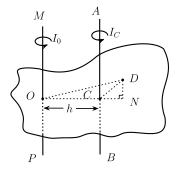
The theorem of parallel axes applies to ANY rigid object (of any shape, not necessarily flat), and requires two axes that are PARALLEL to each other, with (at least) one of the two passing through the object's centre of mass. Let axis MOP pass through an arbitrary point O, and let a second, parallel, axis ACB pass through the object's centre of mass C, with the two axes separated by a fixed perpendicular distance . Consider a mass element dm located at point D; drop the perpendicular DN from D onto the line joining O and C (extended if necessary, so that N lies on that line). Then (about the centre-of-mass axis) and (about the axis through O).
Drawn by us to help you understand the concept clearly, and verified to make sure it's accurate. For exams, practice from your textbook's own diagram.
What this figure shows. An irregularly-shaped rigid object of mass M, with TWO parallel axes drawn perpendicular to the page: axis MOP passing through an arbitrary point O, and axis ACB passing through the object's centre of mass C, at a fixed perpendicular distance h = CO from axis MOP. A mass element dm is marked at point D somewhere in the object, with a perpendicular DN dropped from D onto the (extended) line OC, so that N lies on that line between (or beyond) O and C. Three distances are thus marked and related by right-angle geometry: DO (distance of dm from axis O), DC (distance of dm from axis C), and the segments ON, NC along the line joining the t …
From the right-angled triangles sharing the foot N, and , and since , Integrating this over the whole object (multiplying by dm and summing): Now, NC is the (signed) distance of a mass element from the centre of mass, measured along the line joining the two axes -- and by the very DEFINITION of the centre of mass, any mass distribution is symmetric about it in exactly the sense that (positive and negative contributions on either side of C exactly cancel). This eliminates the middle (cross) term entirely, leaving the clean result In words: the moment of inertia of an object about ANY axis equals its moment of inertia about a PARALLEL axis through its own centre of mass, PLUS the product of its total mass and the square of th …