Physics · Ch 4 — Thermodynamics
Thermodynamic System and Thermodynamic Process
Thermodynamic System and Thermodynamic Process
Before internal energy changes can be discussed quantitatively, two pieces of vocabulary need to be pinned down precisely: what exactly counts as a 'system', and what counts as a 'process'.
A thermodynamic system is any object or collection of objects, grouped together as a single unit, that is capable of exchanging energy with its surroundings. Everything that is not part of the system — everything outside its defined boundary — is called its surroundings or environment. Take water sitting in a vessel as an example: the water itself is the system, the vessel is the system's boundary, and the surrounding atmosphere (and everything else outside the vessel) is the environment.
Thermodynamic systems are classified into three types, based on what they allow to cross their boundary:
- An open system allows both energy and matter to be freely exchanged with its environment. Water boiling in an open kettle is a classic example: heat escapes into the surrounding air (an energy exchange), and steam also escapes into the air (a matter exchange).
- A closed system allows energy to be exchanged, but not matter. Water boiling in a sealed boiler is closed: heat is transferred from the burner into the water and from the water to its surroundings, but as long as the valve stays shut, no steam (matter) can escape.
- An isolated system allows neither energy nor matter to cross its boundary at all — it is completely sealed off. A thermos flask is the familiar everyday example: it is specifically designed to prevent both heat loss and any exchange of its contents with the outside.
A thermodynamic process is any procedure that changes a system's thermodynamic state — that is, changes the values of its state variables. Continuing the boiling-water example: if you seal water in a vessel and heat it externally, the water eventually starts boiling and produces steam that presses on the vessel's walls. Throughout this, the water's temperature , volume , and pressure are all changing — this changing sequence of states is precisely what a thermodynamic process describes. …
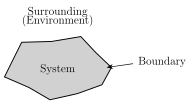
Drawn by us to help you understand the concept clearly, and verified to make sure it's accurate. For exams, practice from your textbook's own diagram.
What this figure shows. A thermodynamic system is the region we choose to study (the shaded blob); everything outside it is the environment or surroundings; the boundary is the real or imagined surface separating the two. Heat and work are exchanged across this boundary, so defining it cle …
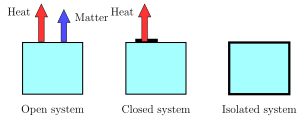
Drawn by us to help you understand the concept clearly, and verified to make sure it's accurate. For exams, practice from your textbook's own diagram.
What this figure shows. Three boxes contrasting the system types. An OPEN system exchanges both matter and energy with its surroundings (arrows for both); a CLOSED system exchanges energy but not matter (energy arrow only); an ISOLATED system exchanges neither (no arrows). The gas-in-a-cylinder used …