Physics · Ch 4 — Thermodynamics
Heat
Heat
With the sign convention for energy transfer now fixed, we can define heat precisely. Consider a glass of water on a table (the system), at temperature , with the table and the rest of the room as its environment, at temperature . If , the water's temperature will keep changing until the water and its surroundings reach a common temperature — thermal equilibrium is re-established between the 'system' and the 'environment'. (If the environment is very large — imagine a huge room — its own temperature change may be too small to notice, but it will not be exactly zero.)
This change in temperature is driven by a transfer of internal energy between the system and its environment. We define heat, denoted , as exactly this: the energy transferred between a system and its environment purely because of a temperature difference between the two.
Three distinct cases follow directly from the sign convention:
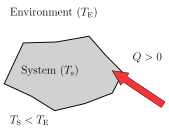
- If (the environment is hotter than the system), energy flows into the system, so the system gains energy and is positive.
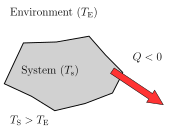
- If (the system is hotter than the environment), energy flows out of the system, so the system loses energy and is negative.
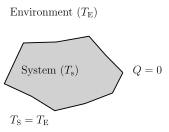
- If (system and environment are already in thermal equilibrium), there is no net transfer of energy at all, so . …
Drawn by us to help you understand the concept clearly, and verified to make sure it's accurate. For exams, practice from your textbook's own diagram.
What this figure shows. An arrow pointing into the system blob marks heat added to the system; by the sign convention of this chapter, heat supplied TO the system is taken positive (Q > 0). Added heat tends to raise the system …
Drawn by us to help you understand the concept clearly, and verified to make sure it's accurate. For exams, practice from your textbook's own diagram.
What this figure shows. An arrow pointing out of the system blob marks heat rejected by the system; heat leaving the system is taken negative (Q < 0). Rejected heat tends to lower the interna …
Drawn by us to help you understand the concept clearly, and verified to make sure it's accurate. For exams, practice from your textbook's own diagram.
What this figure shows. No heat arrow crosses the boundary: there is no heat exchange with the surroundings (Q = 0). This is the adiabatic situation, achieved by insulating the system or by making the change s …