Physics · Ch 4 — Thermodynamics
Heat Flow from a Colder Region to a Hotter Region
Heat Flow from a Colder Region to a Hotter Region
As will be stated formally in Section 4.10 (the Clausius statement of the Second Law), heat can never flow spontaneously, on its own, from a region of lower temperature to a region of higher temperature. However, this natural direction CAN be forced into reverse — heat CAN be made to flow from a colder region to a hotter one — provided external work is done on the system to make it happen. This is exactly the operating principle shared by refrigerators, air conditioners, and heat pumps: all three are heat engines that cause heat to be transferred from a cold region to a hot region, at the cost of consuming mechanical work. …
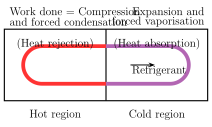
Drawn by us to help you understand the concept clearly, and verified to make sure it's accurate. For exams, practice from your textbook's own diagram.
What this figure shows. A refrigerant circulates in a closed loop between a cold region and a hot region. On the cold side it evaporates, absorbing heat (heat absorption); on the hot side it is compressed and condensed, rejecting that heat plus the compressor work (heat rejection). Heat is thus pumped from cold to hot — …