Physics · Ch 4 — Thermodynamics
Refrigerator
Refrigerator
Refrigeration is the process of cooling a space, or a substance, and/or maintaining its temperature below the temperature of its surroundings — in short, refrigeration is simply artificial cooling. A refrigerator extracts heat from a cold region (the inside of its chamber/compartments) and delivers that heat to the warmer surrounding atmosphere, cooling the interior further in the process. This is exactly why the air behind a running refrigerator feels warm to the touch — the heat extracted from inside the refrigerator, plus the extra work done by the compressor, is all being dumped into the room air at the back — even while the interior of the refrigerator itself stays cold. An air conditioner works on precisely the same underlying principle (Section 4.9.4).
A typical household refrigerator's mechanism has three main parts: a compressor, an expansion valve, and a closed tube that carries the refrigerant fluid (a substance such as isobutane) around a loop. Part of this tube — the cooling coil — sits inside the chamber being cooled, at lower temperature and lower pressure; the rest of the tube is exposed to the surrounding atmosphere, at higher temperature and higher pressure. In both the cold and hot parts of the coil, the refrigerant is normally present as a mixture of liquid and vapour phases in equilibrium.
One complete refrigeration cycle proceeds through four steps:
Step 1. The fluid passes through the expansion valve/nozzle and expands into a low-pressure area — much like carbon dioxide rushing out of a fire extinguisher and cooling as it does — turning partly into gas and cooling sharply. This step is essentially an adiabatic expansion.
Step 2. The now-cool gas is in thermal contact with the inside of the refrigerator's chamber. It absorbs heat from the fridge's contents, warming up slightly as it does; this happens at roughly constant pressure, so it is an isobaric expansion (or evaporation).
Step 3. The gas is transferred to the compressor, which does the bulk of the mechanical work in the whole cycle: it compresses the gas adiabatically, which heats it up and turns it back into a liquid. …
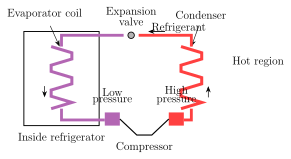
Drawn by us to help you understand the concept clearly, and verified to make sure it's accurate. For exams, practice from your textbook's own diagram.
What this figure shows. The refrigerant leaves the compressor as a hot high-pressure gas, is cooled and condensed in the condenser (hot region), passes through the expansion valve where it drops to low pressure and cools, then absorbs heat from inside the fridge in the evaporator coil before returning to the compressor. The eva …