Physics · Ch 4 — Thermodynamics
Performance of a Refrigerator
Performance of a Refrigerator
Applying the First Law to a refrigerator's repeating cycle is exactly the same as applying it to a heat engine's cycle, since a refrigerator IS just a heat engine run backward: over one full cycle, , so by Eq. (4.21), where the same sign conventions apply.
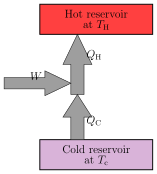
For a refrigerator specifically, heat is absorbed FROM the cold reservoir (, heat entering the working substance from the cold region) and rejected TO the hot reservoir (, heat leaving the working substance into the hot region), and work is done ON the working substance (, since the compressor is doing work on the refrigerant, not the other way round). Working through the signs carefully with these conventions gives:
So the magnitude of the heat rejected at the hot reservoir is always greater than the heat absorbed at the cold reservoir — by exactly the amount of work put in.
The coefficient of performance (CoP), denoted (kappa), measures how well a refrigerator performs, defined as the ratio of the heat extracted from the cold reservoir to the work needed to extract it:
A LARGER means a BETTER refrigerator: it means more heat can be extracted from the cold region for a given amount of work input (or, equivalently, less work is needed to extract a given amount of heat). Since , and are all energy quantities, itself is dimensionless. A typical household refrigerator has .
For an air conditioner, an equivalent CoP is defined as , but it is often more useful to express this in terms of rates: define the heat current (the rate at which heat is removed from the cold space) and the power (the rate at which work is being done, i.e. the compressor's power consumption), where is the time over which is removed. Then:
Typical room air conditioners have in the range 2.5 to 3.0 — lower than a typical refrigerator's CoP, largely because an air conditioner must move heat across a smaller temperature gap relative to a much larger volume of air. …
Drawn by us to help you understand the concept clearly, and verified to make sure it's accurate. For exams, practice from your textbook's own diagram.
What this figure shows. The energy bookkeeping of a refrigerator: heat QC is drawn from the cold reservoir, the compressor supplies work W, and the total is rejected as QH to the hot reservoir, with |QH| = |QC| + |W|. The heat dumped to the hot side always exceeds the heat remov …