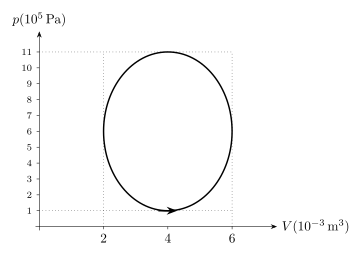
Q.A hypothetical thermodynamic cycle is shown in the figure. Calculate the work done in 25 cycles. [content not fully recoverable from extraction — the printed p-V cycle figure with its numbered pressure/volume coordinates did not survive text extraction, so the numeric work-per-cycle cannot be verified; a partial answer fragment printed elsewhere on the same page reads "AB = 2.4×10^6 J, CD = -8×10^5 J, BC and DA zero, because constant volume change" but its exact pairing with this question cannot be confirmed against the source]
You're viewing a preview — the full solution, concept, methods & PYQ mapping are locked.
Start your 14-day free trial to unlock the full solution →Concept understanding — Cyclic Process
A cyclic process is one in which a thermodynamic system, after undergoing a series of changes, returns exactly to its initial state. Since the system's state variables (and hence its internal energy, a state variable) return to their starting values, the net change in internal energy over one complete cycle is always zero, . Applying the first law over the full cycle then gives : the net work done by the system in one cycle exactly equals the net heat absorbed. On a P-V diagram, a cyclic process appears as a closed loop, and the area enclosed by that loop equals the magnitude of the net work done in the cycle -- if the loop is traced clockwise, the net work done is positive (net work is done BY the sy …
Unlock everything free for 14 days
- Full step-by-step solutions
- Concept-first explanations
- Methods, shortcuts & mistakes
- PYQ mapping + timed mock tests
Full access for 14 days. No credit card required.