Q.The total work done in the cyclic process shown in Fig. 4.19 is −1000 J.
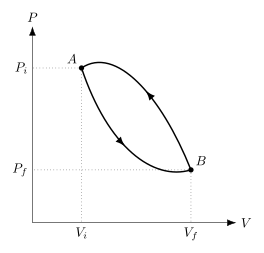
A negative cyclic work means the loop is traversed counter-clockwise (work on the system); ΔU = 0 so Q = W = −1000 J; reversing direction flips the sign.
(a) The work done along A→B (expansion, volume increasing) is positive, and along B→A (compression) is negative and larger in magnitude, so the net work for the loop is negative — the loop is traversed counter-clockwise and net work is done ON the system.
(b) For any cyclic process the system returns to its starting state, so ΔU = 0. The first law then gives
so 1000 J of heat must be rejected by the system.
(c) If the direction of the cycle is reversed (made clockwise), the net work becomes positive: the system does work on the surroundings. A clockwise cyclic process does positive net work; a counter-clockwise one does negative net work.
(a) Net work is done ON the system (counter-clockwise loop). (b) ΔU = 0, so Q = W = −1000 J (1000 J of heat is rejected). (c) Reversing the cycle makes the work positive.
Unlock everything free for 14 days
- Full step-by-step solutions
- Concept-first explanations
- Methods, shortcuts & mistakes
- PYQ mapping + timed mock tests
Full access for 14 days. No credit card required.