Physics · Ch 4 — Thermodynamics
Thermodynamic Equilibrium
Thermodynamic Equilibrium
A property, or equivalently a state variable, of a thermodynamic system is any measurable or observable characteristic of the system while it remains in equilibrium — pressure, volume, temperature, density, and mass are the most common examples used to describe a gas.
State variables further split into two categories, based on how they behave if you imagine dividing the system into two equal halves:
- Intensive variables do not depend on the size (extent) of the system. If a system in equilibrium is split into two equal compartments, each with half the original volume, the pressure , temperature , and density are found to be the same in both halves — these are intensive variables.
- Extensive variables DO depend on the size of the system. In the same split, the total mass and the total internal energy are each divided equally between the two compartments — these are extensive variables.
A system is said to be in thermodynamic equilibrium only when three separate conditions are all satisfied simultaneously:
-
Mechanical equilibrium — there are no unbalanced forces within the system, or between the system and its surroundings; equivalently, the pressure is uniform throughout the system (and matches the surroundings' pressure at the boundary) and does not change with time. Any unbalanced force present will, given time, get neutralised until this condition is reached.
-
Chemical equilibrium — no chemical reactions are occurring within the system, and there is no ongoing diffusion-driven transfer of matter from one part of the system to another; equivalently, the system's chemical composition is uniform throughout and unchanging in time.
-
Thermal equilibrium — the system's temperature is uniform throughout and constant in time (this is the same condition introduced in Section 4.2, now applied within a single system rather than just between two separate systems). …
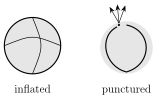
Drawn by us to help you understand the concept clearly, and verified to make sure it's accurate. For exams, practice from your textbook's own diagram.
What this figure shows. An inflated ball beside a punctured one. When a ball is punctured the air inside expands suddenly into the atmosphere; during this rapid expansion the pressure and temperature of the air are not uniform, so the system is NOT in thermodynamic equilibrium and cannot be describe …