Physics · Ch 4 — Thermodynamics
Thermodynamic State Variables and Equation of State
Thermodynamic State Variables and Equation of State
Every equilibrium state of a thermodynamic system is completely and uniquely described by specific values of its macroscopic state variables. For a gas, this typically means its pressure , volume , temperature , and mass (or, equivalently, the number of moles ). For a mixture of gases or vapours — such as the fuel-air mixture in an automobile engine — the state also needs the mixture's composition specified, in addition to , and .
A system's state variables are not all mutually independent; they are related to each other through a mathematical relationship called the equation of state. For an ideal gas, this is the familiar ideal gas equation:
where , , and are the gas's pressure, volume and temperature, is the number of moles present, and is the universal gas constant. A direct consequence of Eq. (4.5) is that for a fixed amount of gas (fixed ), only two of the three variables , , are actually independent — once any two are chosen, the equation of state fixes the third automatically. This is why, throughout the rest of the chapter, a process is typically described by specifying which pair of variables is being varied (and which one is being held fixed). …
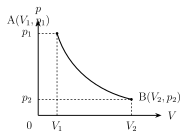
Drawn by us to help you understand the concept clearly, and verified to make sure it's accurate. For exams, practice from your textbook's own diagram.
What this p-V diagram shows. The graph plots pressure p (vertical axis) against volume V (horizontal axis); the area under the curve equals the work done during the process, and the shape of the path tells you how pressure and volume change tog …