Physics · Ch 7 — Wave Optics
Methods for Obtaining Coherent Sources
Methods for Obtaining Coherent Sources
Young's double slit is not the only way to obtain two coherent light sources from one original source. All of the methods surveyed in this section share the same underlying strategy of DIVISION OF WAVEFRONT -- splitting one incoming wavefront geometrically into two separate paths, each of which then behaves as its own coherent virtual source, exactly as the two slits themselves do -- but implement it using different optical components.
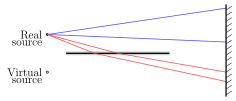
LLOYD'S MIRROR (Fig. 7.12) uses a plane mirror held nearly edge-on to an incoming beam of light from a source S, so the light strikes the mirror surface at GRAZING incidence (very close to 90° from the normal). Some light from S travels directly to a viewing screen; other light strikes the mirror and reflects towards the same screen region, appearing (by the ordinary rule for images in a plane mirror) to originate from a VIRTUAL image source S' located behind the mirror. Since both the real source S and its virtual image S' ultimately trace back to the single original source S, they form a genuinely coherent pair, and where the direct and reflected beams overlap, an interference pattern (mathematically identical in form to Young's double-slit pattern, with S and S' playing the roles of ) is produced.
Drawn by us to help you understand the concept clearly, and verified to make sure it's accurate. For exams, practice from your textbook's own diagram.
What this figure shows. Light from a real source grazes a plane mirror. Some light reaches the screen directly; the rest arrives after reflection, appearing to come from a virtual source below the mirror. The real and virtual sources are coherent (derived from one s …
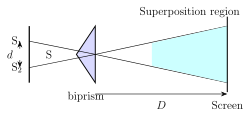
A FRESNEL BIPRISM (Fig. 7.13) is a single prism-shaped piece of glass whose vertex angle is very obtuse -- close to 180° -- so that it behaves, in effect, as two extremely thin prisms of small refracting angle joined base-to-base along one common edge, which is kept parallel to the length of an illuminated slit S. Each half of the biprism refracts (bends) the light striking it slightly towards its own base, so the upper half forms a virtual image of S deflected one way and the lower half forms another virtual image deflected the other way -- two virtual images, and , both derived from the single original slit S and hence coherent. Where the two correspondingly-diverging refracted beams overlap (the shaded region in Fig. 7.13), an interference pattern indistinguishable in form from Young's double-slit pattern is produced, with the biprism's effective virtual-source separation playing the role of the slit separation d (Example 7.5 works through finding this effective d from the biprism's refracting angle, refractive index, and distances).
Drawn by us to help you understand the concept clearly, and verified to make sure it's accurate. For exams, practice from your textbook's own diagram.
What this figure shows. A Fresnel biprism (two thin prisms base-to-base) refracts light from a narrow slit S into two overlapping beams, as if coming from two virtual sources S1 and S2. These are coherent, and interference fringes form in the shaded reg …
…