Q.Draw and label the parts of the leaf.
You're viewing a preview — the full solution, concept, methods & PYQ mapping are locked.
Start your 14-day free trial to unlock the full solution →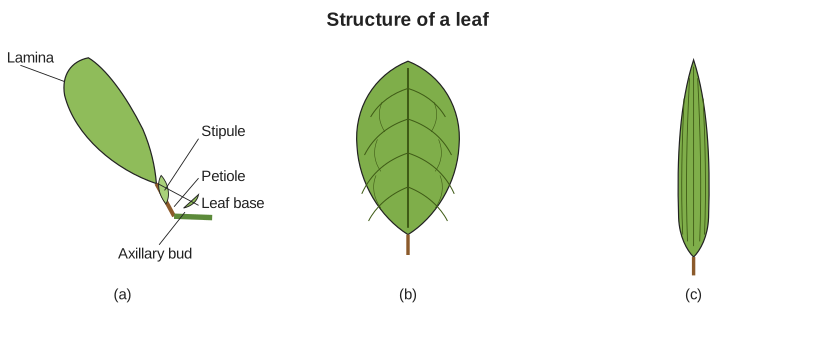
A leaf is drawn and labelled showing three main regions — leaf base, petiole, and lamina — with the lamina further labelled for its midrib, veins, margin, and apex; a hand-drawn diagram cannot be produced in this text format, so every part that the diagram must show and label is listed here in full instead.
Note on this answer: this question asks the student to physically draw and label a leaf diagram. A visual drawing cannot be produced in this text-based answer format, so instead every structure that a correctly labelled diagram must include is described here, so the answer remains complete and usable for study/labelling purposes:
-
Leaf base: the region where the leaf attaches to the node of the stem; in some plants it is swollen (pulvinus) or sheathing (as in grasses).
-
Stipules: a pair of small, leaf-like outgrowths present at the leaf base in many (though not all) plants; leaves with stipules are called stipulate, and those without are exstipulate.
-
Petiole: the stalk of the leaf that attaches the lamina to the stem/leaf base; leaves with a petiole are petiolate, and those without (lamina attached directly to stem) are sessile.
-
Lamina (leaf blade): the flat, expanded, usually green part of the leaf where most photosynthesis occurs. Within the lamina, the following are labelled:
- Midrib: the prominent central vein running from the base to the tip of the lamina.
- Lateral veins and veinlets: the branching network of smaller veins arising from the midrib (venation pattern — reticulate in dicots, parallel in monocots). …
Unlock everything free for 14 days
- Full step-by-step solutions
- Concept-first explanations
- Methods, shortcuts & mistakes
- PYQ mapping + timed mock tests
Full access for 14 days. No credit card required.