Q.(a) Discuss the formation of N2 molecule using MO theory with diagram. OR
You're viewing a preview — the full solution, concept, methods & PYQ mapping are locked.
Start your 14-day free trial to unlock the full solution →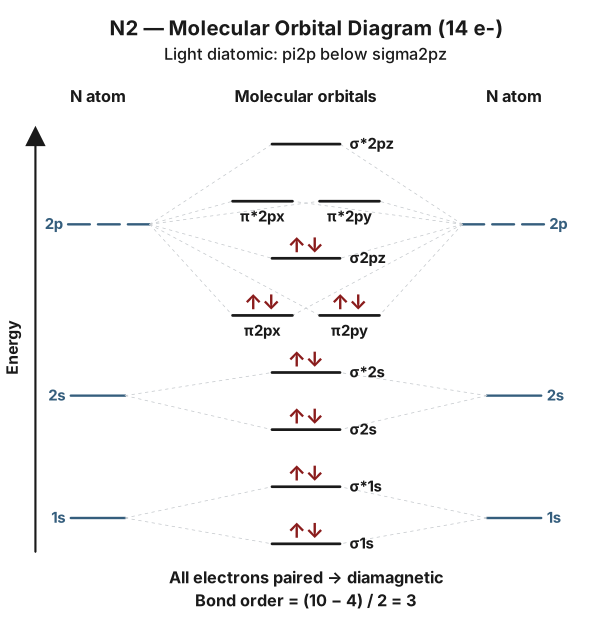
N2's 14 electrons fill the MOs as sigma1s2 sigma1s2 sigma2s2 sigma2s2 pi2p4 sigma2p2, giving bond order 3 (a triple bond) and no unpaired electrons (diamagnetic), consistent with N2's very strong, short, and unreactive bond.
Answering part (a), since it is given as the primary alternative (the OR alternative (b), on IUPAC naming and beta-elimination, is not required unless (a) is unanswerable):
Each nitrogen atom has 7 electrons, so N2 has a total of 14 electrons to place into molecular orbitals (MOs), formed by the linear combination of the atomic orbitals of the two nitrogen atoms.
For N2 (and other diatomics up to N2 in Period 2, where 2s-2p mixing raises the energy of the sigma2p MO above the pi2p MOs), the molecular orbitals fill in this order of increasing energy:
sigma1s < sigma1s < sigma2s < sigma2s < (pi2px = pi2py) < sigma2pz < (pi2px = pi2py) < sigma*2pz
Filling all 14 electrons, two at a time, from lowest energy upward:
sigma1s2 sigma1s2 sigma2s2 sigma2s2 (pi2px2 pi2py2) sigma2pz2
(This accounts for 2+2+2+2+2+2+2 = 14 electrons.)
Counting bonding vs antibonding electrons:
- Bonding electrons: sigma1s2 + sigma2s2 + pi2px2 + pi2py2 + sigma2pz2 = 2+2+2+2+2 = 10
- Antibonding electrons: sigma1s2 + sigma2s2 = 2+2 = 4
Bond order = (Number of bonding electrons - Number of antibonding electrons) / 2 = (10 - 4) / 2 = 3
…
Unlock everything free for 14 days
- Full step-by-step solutions
- Concept-first explanations
- Methods, shortcuts & mistakes
- PYQ mapping + timed mock tests
Full access for 14 days. No credit card required.