Q.(a) Discuss the formation of O2 molecule using Molecular Orbital (MO) theory with diagram. OR
You're viewing a preview — the full solution, concept, methods & PYQ mapping are locked.
Start your 14-day free trial to unlock the full solution →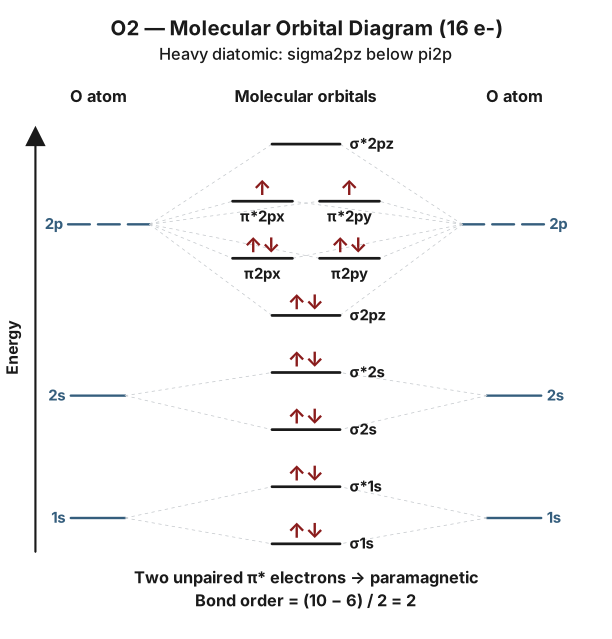
Molecular Orbital theory builds O2's bonding by combining the atomic orbitals of the two oxygen atoms into bonding and antibonding molecular orbitals; filling these gives a bond order of 2 (consistent with the O=O double bond) and correctly predicts that O2 is paramagnetic, something Valence Bond theory cannot explain.
Molecular Orbital (MO) theory treats a molecule as a single system in which atomic orbitals of the combining atoms merge to form new molecular orbitals — each combination of two atomic orbitals gives one lower-energy bonding MO and one higher-energy antibonding MO (marked with a star, *). Electrons are then filled into these MOs following the Aufbau principle (lowest energy first), the Pauli exclusion principle, and Hund's rule (degenerate orbitals are singly filled before pairing).
Each oxygen atom (Z = 8) has the electron configuration 1s2 2s2 2p4, so O2 has 16 electrons total. Combining the 1s, 2s, and 2p atomic orbitals of the two oxygen atoms, the molecular orbital energy level diagram for O2 (energy increasing left to right) is:
σ1s < σ1s < σ2s < σ2s < σ2pz < (π2px = π2py, degenerate pair) < (π2px = π2py, degenerate pair) < σ*2pz
(Note: for O2, F2, and Ne2 — elements after nitrogen — the σ2pz orbital lies LOWER in energy than the π2p orbitals, unlike for B2, C2, N2 where the order of σ2pz and π2p is reversed.)
Filling the 16 electrons of O2 into this diagram in order:
σ1s2 σ1s2 σ2s2 σ2s2 σ2pz2 π2px2 π2py2 π2px1 π2py1
The 1s-derived orbitals (σ1s2 σ*1s2, often abbreviated 'KK' since they correspond to the inner K-shells) are fully filled bonding+antibonding pairs and cancel out, so they are ignored when calculating bond order. Looking at the remaining (valence) orbitals:
- Bonding electrons: σ2s(2) + σ2pz(2) + π2px(2) + π2py(2) = 8
- Antibonding electrons: σ2s(2) + π2px(1) + π*2py(1) = 4
Bond order = (Number of bonding electrons - Number of antibonding electrons) / 2 = (8 - 4)/2 = 2
…
Unlock everything free for 14 days
- Full step-by-step solutions
- Concept-first explanations
- Methods, shortcuts & mistakes
- PYQ mapping + timed mock tests
Full access for 14 days. No credit card required.