Q.Draw the diagram of immunoglobulin molecule and label the parts. [figure: immunoglobulin (antibody) molecule structure diagram, to be drawn and labelled by the candidate — not printed in the question paper]
You're viewing a preview — the full solution, concept, methods & PYQ mapping are locked.
Start your 14-day free trial to unlock the full solution →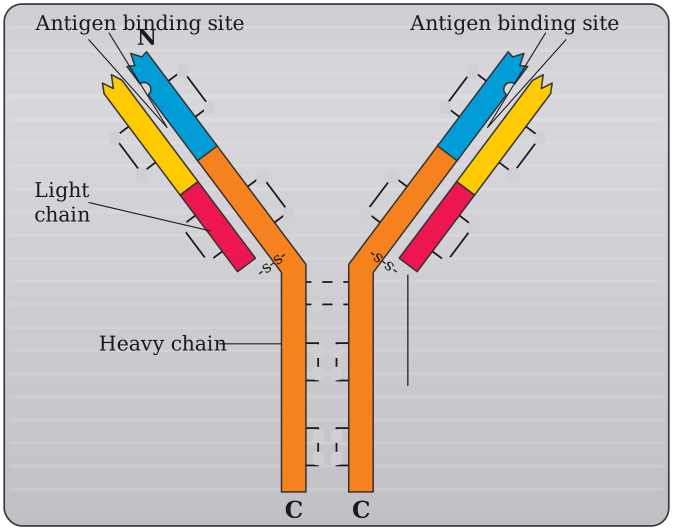
An antibody is a Y-shaped protein of two heavy and two light chains linked by disulfide bonds, with variable antigen-binding tips (Fab region) and a constant Fc stem, joined by a hinge.
Each immunoglobulin monomer is built from four polypeptide chains: two identical, longer Heavy (H) chains and two identical, shorter Light (L) chains, linked to each other by covalent disulfide (-S-S-) bonds, giving the molecule its characteristic Y-shape. Each of the four chains is divided into a Variable (V) region, located at the amino-terminal tip of each arm, whose amino-acid sequence differs between antibodies and forms the specific antigen-binding site, and a Constant (C) region, whose sequence is largely fixed for a given antibody class. The two identical arms of the Y, each containing a light chain and part of a heavy chain, together make up the Fab (Fragment, antigen-binding) region, responsible for recognising and binding a specific antigen. The stem of the Y, formed by the remaining constant portions of the two heavy chains, is the Fc (Fragment, crystallisable) region, which interacts with immune cell receptors and complem …
Unlock everything free for 14 days
- Full step-by-step solutions
- Concept-first explanations
- Methods, shortcuts & mistakes
- PYQ mapping + timed mock tests
Full access for 14 days. No credit card required.