Q.What is a transistor? By drawing the circuit diagram of the common emitter configuration, plot the output characteristics.
You're viewing a preview — the full solution, concept, methods & PYQ mapping are locked.
Start your 14-day free trial to unlock the full solution →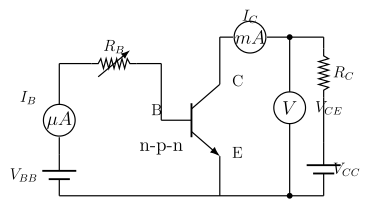
A transistor is a 3-terminal, 2-junction device; its CE output characteristic plots against for constant , nearly flat in the active region.
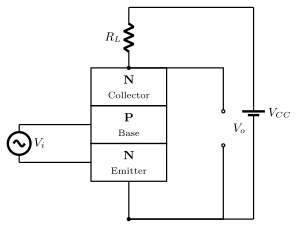
Transistor: A junction transistor is a semiconductor device made of three doped regions — emitter (E), base (B) and collector (C) — forming two P-N junctions (N-P-N or P-N-P). The thin, lightly doped base sits between a heavily doped emitter and a moderately doped collector. It is used to amplify weak signals and as a switch.
Common-emitter circuit: The emitter is common to both loops. The emitter–base junction is forward biased by and the collector–base junction reverse biased by ; input is applied between base and emitter, output taken between collector and emitter.
            +-----[R_C]---+---o V_CE (+)
            |             C
  I_B    B  |    N-P-N   (collector)
  o--[R_B]--+--( base )
            |             E
  V_BB      |             |
  (+)-------+-------------+---o (emitter, common)
Output characteristics: These are graphs of collector current versus collector–emitter voltage , drawn for several fixed base currents :
 I_C
  |            ______________  I_B = 30 µA …
Unlock everything free for 14 days
- Full step-by-step solutions
- Concept-first explanations
- Methods, shortcuts & mistakes
- PYQ mapping + timed mock tests
Full access for 14 days. No credit card required.