Question of 37
Q.Draw the circuit diagram of a P-N-P transistor in CE configuration.
Odisha ChseOdisha CHSE +2 Science Board Exam 2020Subjective· 2mImportance★★★★★
0% · 0/37 Questions
You're viewing a preview — the full solution, concept, methods & PYQ mapping are locked.
Start your 14-day free trial to unlock the full solution →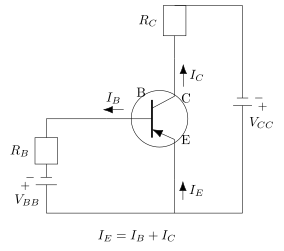
A PNP transistor in common-emitter (CE) configuration has the emitter forward-biased with respect to the base and the collector reverse-biased with respect to the base, with the emitter terminal common to both the input and output circuits.
(A text description of the circuit is given below, since no image can be rendered in this format.)
Circuit description:
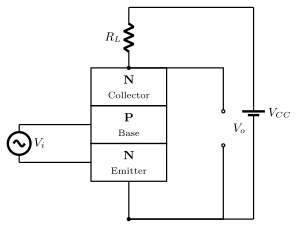
- The transistor has three regions: emitter (P), base (N), collector (P) — hence PNP.
- Input (base) circuit: A battery (or ) is connected between the emitter and base, through a base resistor , such that the emitter (P-region) is at a higher potential than the base (N-region) — this forward-biases the emitter–base junction. For a PNP transistor the emitter arrow (in the standard symbol) points inward, toward the base, indicating conventional current flows from emitter into the base.
- Output (collector) circuit: A second battery is connected between the collector and emitter, through a load resistor in series with the collector, oriented so that the collector (P-region) is at a lower potential than the base (N-region) — this reverse-biases the collector–base junction.
- Common terminal: The emitter is common to both the input loop (––base–emitter) and the output loop (––collector–emitter), which is why this arrangement is called the common-emitter (CE) configuration. …
Unlock everything free for 14 days
- Full step-by-step solutions
- Concept-first explanations
- Methods, shortcuts & mistakes
- PYQ mapping + timed mock tests
Full access for 14 days. No credit card required.