Q.A car travels 400 m due east along a straight road in 20 s, then reverses direction and travels 150 m due west in 10 s. Find
(a) the average speed and
(b) the average velocity of the car for the entire 30 s journey.
West Bengal WbchseTextbookSubjectiveImportance★★★★★est
8% · 2/24 Questions
✓ Free question
Concept understanding — Average Speed vs Velocity
Average Speed vs Velocity: The Intuition First
Imagine you're walking home from school. You take a shortcut through a park, then stop to buy a snack, then realise you forgot something and run back a bit, then finally walk home. By the time you reach your front door, you've walked a total of 2 km — but your house is only 500 metres from school in a straight line.
That difference — between the total ground you covered and how far you actually ended up from where you started — is the entire point of speed vs velocity.
The Precise Definitions
Average speed is a measure of how fast something is moving overall. It cares only about the total distance travelled, not the direction.
Average speed=Total time takenTotal distance travelled
Average velocity is a measure of how fast and in what direction something is moving overall. It cares about the net displacement — the straight-line distance from start to finish, with a direction.
Average velocity=Total time takenDisplacement
Note
Displacement is the straight-line distance from the starting point to the ending point, with a direction. Distance is the total length of the actual path travelled, with no direction.
The Key Difference in One Sentence
Speed is a scalar (just a number, like 5 km/h). Velocity is a vector (a number and a direction, like 5 km/h north).
That one word — direction — changes everything.
A Concrete Example
You walk 3 km east, then 4 km north. The whole trip takes 1 hour.
Total distance travelled = 3 + 4 = 7 km
Displacement = straight line from start to finish = 32+42=5 km, northeast
Now compute:
Average speed=1 h7 km=7 km/h
Average velocity=1 h5 km, northeast=5 km/h, northeast
Watch out
A common mistake: students think average velocity is just "speed with direction". It's not. It's displacement divided by time, not distance divided by time. If you walk in a circle and return to your starting point, your displacement is zero — so your average velocity is zero, even though your average speed is positive.
When Are They Equal?
Only when the motion is in a straight line without changing direction. If you walk 2 km east in a straight line, then distance = displacement, so average speed = magnitude of average velocity.
But the moment you turn, or stop, or go backwards — they diverge.
Why This Matters for Exams
In Indian board exams (CBSE, ICSE, state boards), you will be asked to:
Distinguish between speed and velocity (scalar vs vector)
Calculate average speed and average velocity from given data
Interpret situations where velocity is zero but speed is not (like a round trip)
Important
Always check: does the problem give you distance or displacement? If it says "returns to starting point", displacement = 0, so average velocity = 0 regardless of how fast the object moved.
The Bottom Line
Quantity
Type
Formula
Depends on
Average speed
Scalar
total timetotal distance
Path taken
Average velocity
Vector
total timedisplacement
Start and end points only
Average speed tells you how fast the journey was. Average velocity tells you how effectively you moved from where you started to where you ended.
Searches for "Average Speed vs Velocity notes class 11" and "Average Speed vs Velocity important questions" both point back to this same core idea, since Average Speed vs Velocity sits squarely within the Motion in a Straight Line coverage of NCERT Class 11 Physics, so it is fair game for both CBSE board questions and competitive-exam numericals. The clearest way to build exam confidence here is to combine this explanation with the NCERT Physics textbook's own solved examples and chapter-end questions.
[!TLDR] Average speed uses total path length (400+150=550 m); average velocity uses net displacement (400−150=250 m east), both over 30 s. [!ANSWER] Average speed ≈ 18.3 m/s; average velocity ≈ 8.3 m/s east.
Setting up. Take east as the positive direction. The car travels 400 m east in 20 s, then reverses and travels 150 m west in the next 10 s. Total time Δt=20+10=30 s.
Average speed. This uses the total path length covered, regardless of direction:
total path length=400m+150m=550m
average speed=30s550m≈18.3m/s
Average velocity. This uses the net displacement — the car's final position relative to where it started. Taking east as positive, the car moves +400 m and then −150 m, so its net displacement is
Δx=400−150=250m (east)
vˉ=ΔtΔx=30s250m≈8.3m/s, directed east
Comparison. As expected from Section 2.3, the average speed (≈18.3 m/s) is larger than the magnitude of the average velocity (≈8.3 m/s), because the car reversed direction partway through its journey — the westward leg adds fully to the path length but partially cancels the eastward displacement.
[!ANSWER] Average speed ≈ 18.3 m/s; average velocity ≈ 8.3 m/s, directed east.
Average speed = total path length / total time; average velocity = net (signed) displacement / total time, using a consistent positive direction.
Adding the two displacements as if both were positive, ignoring the reversal in direction
Reporting average velocity without stating its direction
Confusing average speed with average velocity and reporting only one of the two required quantities
Same / Similar Concept — real previous-year questions on the same or a closely similar concept, not this exact question.
CBSE 2025Set ANNUAL1 markMCQ
Q.A cyclist moving on a circular track of radius 40 m completes half a revolution in 40 s. Its average velocity is
(a) zero
(b) 2 m s^-1
(c) 4 pi m s^-1
(d) 8 pi m s^-1
›Reveal solutionSolution
Average velocity uses DISPLACEMENT, not distance travelled; half a revolution displaces the cyclist by one diameter (2r), giving 2 m/s.
Radius r = 40 m, so diameter = 2r = 80 m.
In half a revolution, the cyclist moves from one end of a diameter to the exact opposite end of the circle. The straight-line displacement between these two points equals the diameter, 80 m (NOT the arc length, which is used for average SPEED, not average velocity).
Time taken, t = 40 s.
Average velocity = displacement / time = 80 m / 40 s = 2 m/s.
(Note: average SPEED would instead use the arc length, pir = 40pi m, giving pi m/s -- but the question asks for average velocity, a vector quantity based on net displacement.)
✓Final answer
(b) 2 m s^-1.
CBSE 2018Set ANNUAL1 markMCQ
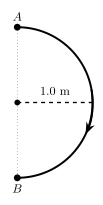
Q.In 1.0 second, a particle goes from point A to point B moving in a semi-circle of radius 1.0m as shown in fig. The magnitude of average velocity is
(a) 3.14 m/s
(b) 2.0 m/s
(c) 1.0 m/s
(d) Zero
›Reveal solutionSolution
Average velocity uses displacement (straight-line distance A to B = diameter), giving 2.0 m/s, not the arc length (which would give average SPEED = 3.14 m/s).
The particle moves along a semicircular arc of radius r = 1.0 m from A to B in time t = 1.0 s.
Displacement (straight line from A to B) = diameter = 2r = 2 x 1.0 = 2.0 m.
Average velocity = displacement / time = 2.0 m / 1.0 s = 2.0 m/s.
(Note: the arc length = pi r = 3.14 m would give the average SPEED = 3.14 m/s — option (a) is a common distractor that uses path length instead of displacement.)