Q.(i) What will happen when bromomethane reacts with an aqueous solution of sodium hydroxide? Write the mechanism of the reaction.
You're viewing a preview — the full solution, concept, methods & PYQ mapping are locked.
Start your 14-day free trial to unlock the full solution →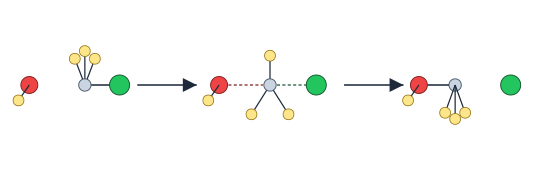
Bromomethane undergoes SN2 substitution with aqueous NaOH to give methanol; chlorobenzene undergoes electrophilic nitration (Cl directs o,p) to give mainly p-chloronitrobenzene.
(i) Bromomethane + aqueous NaOH: Since bromomethane is a primary (methyl) halide, the hydroxide ion, a strong nucleophile, attacks the carbon bearing bromine from the side opposite to the leaving group (backside attack) in a single, concerted step — a bimolecular nucleophilic substitution ().
Mechanism: OH⁻ approaches carbon from the face opposite to Br⁻; a pentacoordinate transition state forms (OH⁻...C...Br⁻ partial bonds); as the C–OH bond forms, the C–Br bond breaks, and the configuration at carbon inverts (Walden inversion, though not stereochemically visible here since CH₃Br has no stereocentre).
…
Unlock everything free for 14 days
- Full step-by-step solutions
- Concept-first explanations
- Methods, shortcuts & mistakes
- PYQ mapping + timed mock tests
Full access for 14 days. No credit card required.